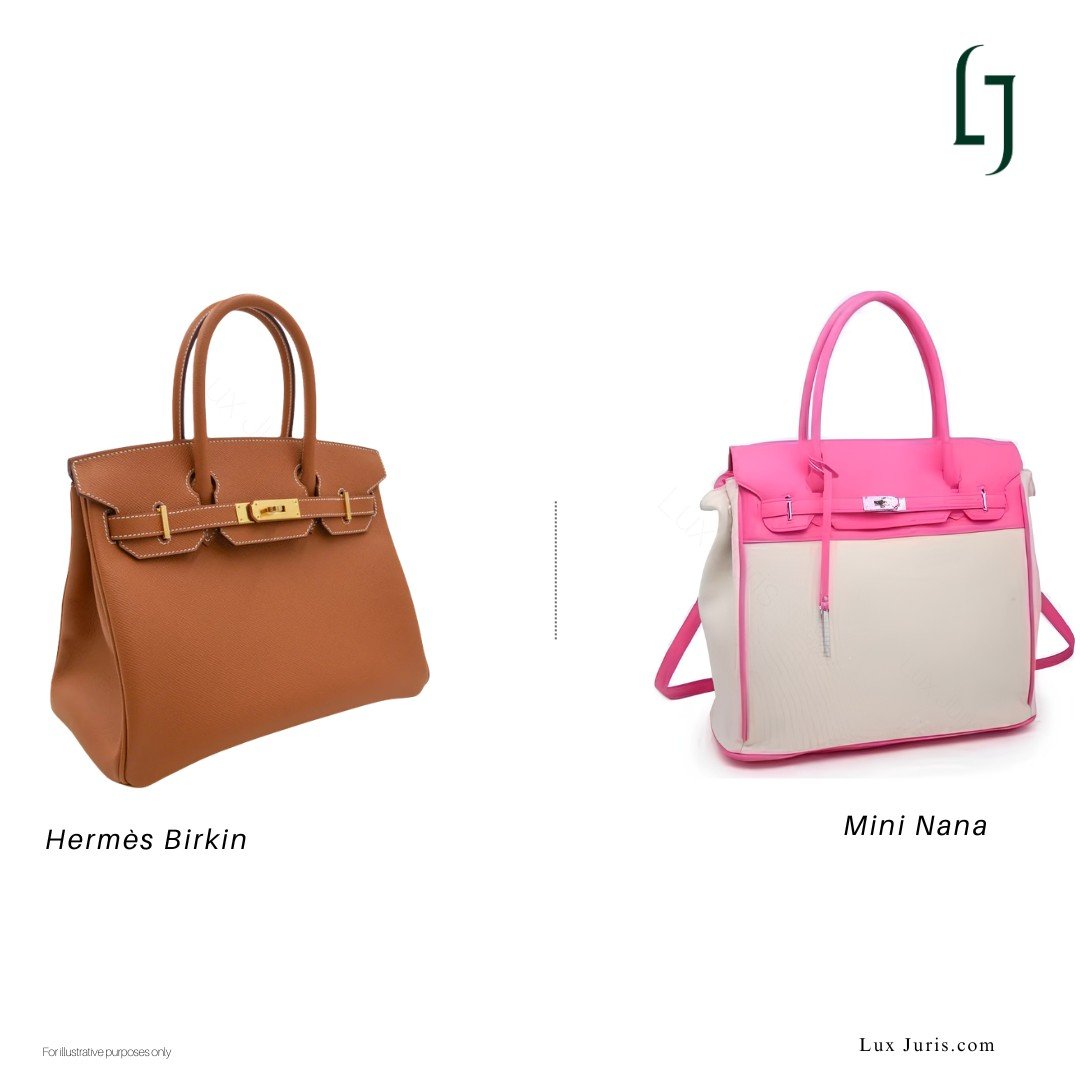
The absence of a logo is often seen as the difference between a counterfeit and a dupe. If a bag is sold without the Hermès name, many assume the legal risk drops significantly. A recent French decision shows why that assumption can be dangerous.
In Hermès vs Mini Nana, the Marseille Judicial Court found that a wholesaler selling low-cost lookalike versions of the Kelly and Birkin had infringed Hermès’ intellectual property rights. Two entities brought the claim. Hermès Sellier, the creative and manufacturing company, owned the copyright in both bag designs. Hermès International, the group holding company, held the registered three-dimensional trademark covering the closure mechanism. While the case involved both rights, the judgment is primarily about copyright. More specifically, it is about how closely a product can resemble an iconic design before it stops being inspired by the original and starts reproducing it.
The dispute arose after Hermès alleged that Mini Nana was selling bags that copied the essential characteristics of the Kelly and Birkin. Before the court could examine those allegations, it first had to deal with a challenge to the evidence itself. Mini Nana argued that the purchase report relied upon by Hermès was invalid because the transaction took place within a wholesale complex rather than a publicly accessible retail environment. The court rejected those arguments, finding that the premises were open during business hours, carried no restricted access signage, and required no invitation or entry fee. The evidence had been obtained lawfully. With that issue resolved, the focus shifted to the bags.
Copyright Was the Real Issue
Although the decision includes a trademark claim, most of the court’s attention was directed towards copyright.
Hermès argued that both the Kelly and the Birkin were protected works and identified the features that together create the appearance of each bag. The court accepted that position.
For the Kelly, it pointed to the combination of the trapezoidal shape, side gussets, cut flap, fastening system comprising leather straps with six-sided perforated metal plates bearing four pearlhead studs sliding into a circular tourniquet, a handle sized for the wrist or forearm with double topstitching, a hexagonal leather clochette, four base studs, and a removable shoulder strap.
For the Birkin, it identified a different combination: a roughly rectangular shape, a three-notch flap with topstitching, a closure system with six-sided metal plates fixed by visible pearlhead studs held by pontets and sliding into a ring-shaped perforated tourniquet, two handles with central topstitching ending in a downward-pointing base cut, side gussets, a hexagonal leather clochette, and four base studs.
What is notable is that the court did not find copyright in any one element viewed in isolation. A handle is not unique to Hermès. Neither is a flap, a clasp or a gusset. The court instead focused on the way those elements were combined. According to the judgment, it was this combination of features that reflected creative and arbitrary choices and gave the Kelly and Birkin their distinctive appearance. The court also confirmed that a utilitarian function does not exclude copyright protection where the overall form reflects an original creative contribution.
This is an important distinction. Fashion designs are often built from common elements that have existed for decades. Copyright protection usually turns on how those elements are arranged rather than on the individual components themselves. The court concluded that the Kelly and Birkin crossed that threshold.
Once that finding was made, the outcome became difficult for Mini Nana to avoid. Comparing the products side by side, the court found that the accused bags reproduced the essential characteristics of both designs. In the court’s view, this was not a case involving a general resemblance or a shared trend. The similarities were sufficiently extensive to amount to copyright infringement.
Why the Decision Matters
The most interesting aspect of the judgment is what it says about products commonly described as dupes.
Many discussions about dupes focus almost entirely on branding. If the logo is absent, the product is often viewed as legally safer than a counterfeit. The Marseille court’s reasoning shows why that analysis is incomplete.
The judgment contains little discussion of fake Hermès labels or attempts to pass products off as genuine Hermès goods. Instead, the court concentrated on the bags themselves. In the copyright analysis, the question was not whether consumers believed they were buying a genuine Hermès product. The question was whether the products reproduced protected intellectual property.
That distinction matters because copyright can reach conduct that trademark law alone may not. A business may avoid copying a logo and still face liability if it reproduces a protected design too closely. In practical terms, removing the name from the product does not automatically remove the legal risk.
The trademark claim illustrates a related but different point. Hermès International relied on international three-dimensional trademark No. 806207, registered in 2003 and regularly renewed, covering the closure mechanism used on both bags. Hermès Sellier exploited that mark under an exclusive licence registered with the INPI. Mini Nana argued that similar clasps were widely used throughout the leather goods industry. The court disagreed. Looking at the overall configuration of the fastening mechanism (six-sided metal plates fixed by pearlhead studs sliding into a ring-shaped tourniquet) it concluded that the similarity created an undeniable risk of consumer confusion, even where the accused bags carried no padlock.
The result was therefore the same under both copyright and trademark law. The products were found to reproduce protected features associated with Hermès.
What the Court Awarded
The damages reflect how seriously the court treated the conduct.
Mini Nana was ordered to pay €75,000 to each of Hermès Sellier and Hermès International for the negative economic consequences of the infringement, and €20,000 to each for moral prejudice. Hermès Sellier recovered a further €20,000 under a third head, the investment savings Mini Nana extracted by free-riding on decades of Hermès brand-building without contributing to the cost of it. The court anchored its economic assessment on Hermès’ 71% gross margin in 2022 and an average Kelly or Birkin sale price of approximately €6,000 ex-tax, against Mini Nana’s wholesale price of between €7.50 and €10 per unit.
Beyond damages, the court imposed a €1,000 per-violation injunction, ordered destruction of all infringing stock at Mini Nana’s expense, and required publication of the judgment in three French newspapers, also at Mini Nana’s expense, capped at €10,000 per publication.
A Case About the Limits of the Dupe Defence
The decision should not be read as a declaration that every lookalike product infringes copyright. Fashion trends, silhouettes and general design ideas remain free for competitors to use. The problem arises when a product moves beyond inspiration and begins to recreate the particular combination of features that gives the original design its identity.
That is what the court found had happened here.
For Hermès, the judgment shows the value of protecting iconic products through multiple intellectual property rights held across the group structure. For businesses selling lookalike goods, the decision shows that the absence of branding is not always a defence. Where a court concludes that the design itself has been copied, liability may follow even without the original logo appearing on the product.