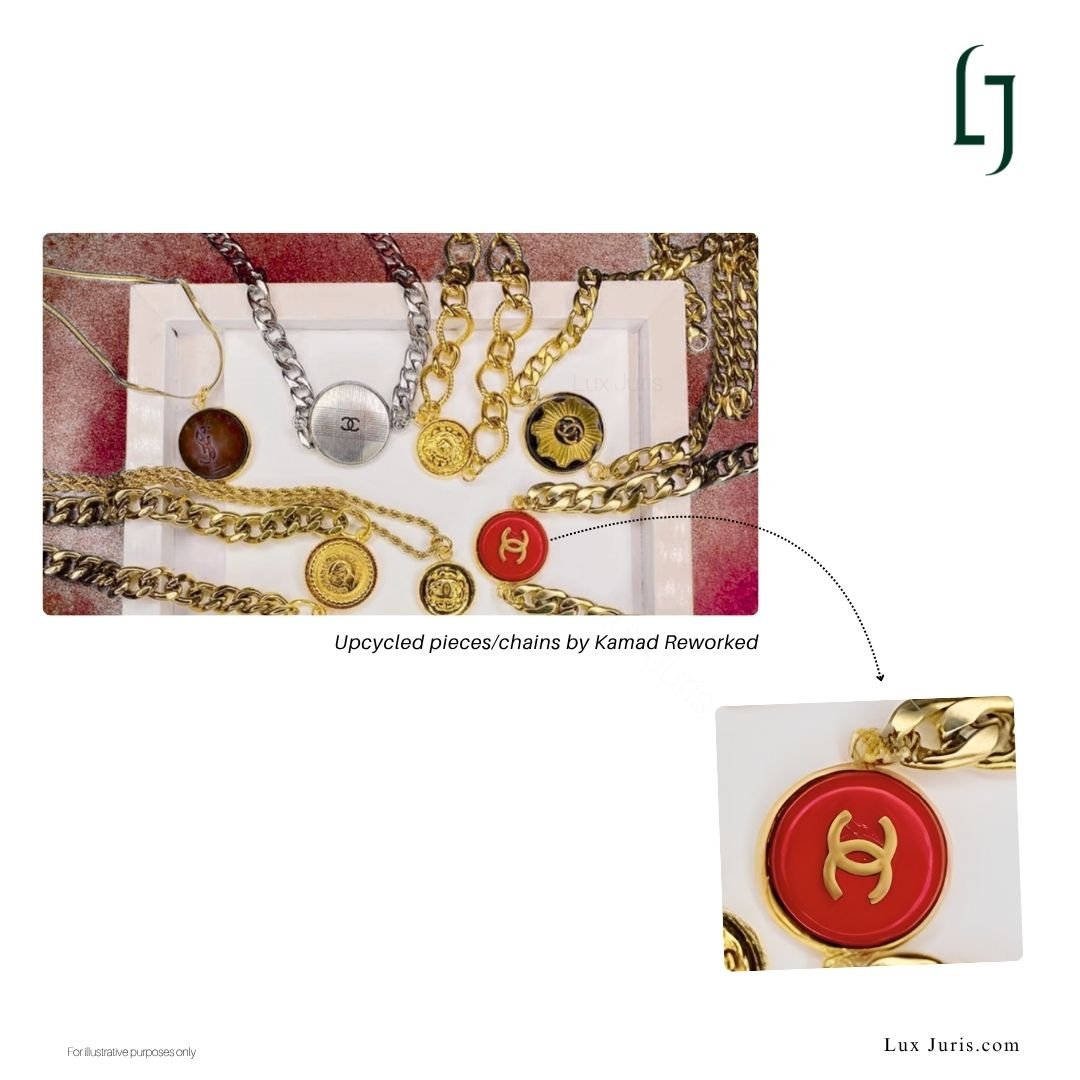
Luxury upcycling has become one of fashion’s most popular sustainability narratives. Designers purchase luxury products, dismantle them, and transform their components into new jewellery, accessories, jackets, and other creations. The process is often presented as a way of extending the life of existing products while reducing waste.
Yet behind the environmental messaging lies a more difficult question: what happens when the most valuable element of the recycled product is not the material itself, but the trademark attached to it?
A judgment delivered by the Paris Judicial Court on 21 May 2026 places that question squarely before the fashion industry. In a dispute between Chanel and Kamad Reworked, the court was asked to determine whether jewellery incorporating Chanel-branded elements could lawfully be sold as upcycled creations, or whether those sales crossed into trademark infringement.
Kamad Reworked did not appear before the court but the proceedings were decided on the basis of Chanel’s evidence alone. Nevertheless, the judgment provides a detailed examination of the legal limits of luxury upcycling and shows that sustainability objectives do not displace trademark rights.
The dispute was never really about recycling
Kamad Reworked sold necklaces, bracelets, belt chains, earrings and other accessories incorporating elements bearing Chanel’s famous interlocking CC monogram and Chanel word marks. According to Chanel’s evidence, the products were marketed as original creations produced through the upcycling of buttons and belt buckles bearing those signs. Customers were informed that they were purchasing Kamad creations rather than Chanel products.
At first glance, the dispute appears to concern the use of authentic luxury components. Before proceedings were issued, Kamad maintained that it was working with genuine second-hand products and transforming them into something new.
The court approached the matter differently.
The central issue was not whether luxury products could be recycled. It was whether Chanel’s trademarks were being used to market and sell new products without Chanel’s consent. Once the dispute was framed in those terms, the legal analysis moved away from sustainability and back into trademark law.
Why authenticity was not enough, and was not even established
A recurring assumption within the upcycling market is that the use of authentic luxury components creates a legal shield. The court rejected that assumption for two separate reasons.
The first was evidentiary. Kamad claimed to be using genuine Chanel components, yet the evidence before the court did not establish the origin of the branded charms (components) incorporated into the products. Nothing before the court allowed it to conclude that those charms originated from products placed on the market within the European Economic Area by Chanel or with Chanel’s consent.
Authenticity of source was therefore not proven.
The second reason was more significant. Even if the components had originated from authentic Chanel products, the court concluded that the exhaustion principle could not apply.
Under European trademark law, a trademark owner generally cannot prevent the resale of products that it has already placed on the market within the European Economic Area. The principle exists to ensure that legitimate second-hand markets can function. It protects resale, not reconstruction.
The court found that the finished jewellery sold by Kamad was not the same product originally marketed by Chanel. The branded elements had been combined with materials from other sources and incorporated into entirely new items. What consumers purchased was therefore not a resold Chanel product but a newly created commercial product.
That finding was enough to remove the case from the scope of trademark exhaustion altogether.
Two distinct infringement routes
The judgment is careful to distinguish between two different forms of trademark infringement.
For the two word marks reproduced identically on certain products, the court found infringement by reproduction. Where an identical sign is used for identical goods, there is no need to undertake a confusion analysis. The infringement follows from the identity of the sign and the goods themselves.
The analysis was different for the interlocking CC monogram.
There, the court examined whether consumers would be likely to believe that the products originated from Chanel or were commercially connected to Chanel. Several factors pointed in the same direction.
The monogram occupied a dominant position on the face of the charms, which themselves formed the central feature of the jewellery. Chanel’s marks were also recognised as highly distinctive and exceptionally well known within the fashion and accessories sector. Faced with those signs, consumers were likely to attribute the products to Chanel or assume some form of commercial connection.
The fact that certain products also bore the words “Kamad Reworked” did not alter that conclusion. Those references appeared on the reverse of the charms and were therefore less visible than the Chanel signs at the point of purchase. At most, they suggested an association between the businesses rather than eliminating confusion altogether.
Why the disclaimers failed, and made things worse
Kamad attempted to distance itself from Chanel through website statements and accompanying documentation.
Customers were informed that they were purchasing a Kamad creation rather than a Chanel creation. Product descriptions also stated that components from luxury brands had been incorporated into the finished products. This line of reasoning failed for two reasons.
The first was practical. The Chanel signs appeared prominently on the products themselves, while the explanatory statements appeared in smaller text and in a less visible position. Consumers were far more likely to notice the trademarks than the disclaimer.
The second reason was more damaging. By expressly informing consumers that components from the named luxury brand had been incorporated into the product, the disclaimer states the very association consumers were already likely to make. Rather than reducing the connection with Chanel, it confirmed it.
The judgment shows that disclaimers do not automatically resolve trademark problems. In some circumstances, they may strengthen the link between the product and the trademark owner.
The certificate created a separate legal problem
The court also examined the certificates of authenticity supplied with each purchase.
Those certificates stated that the item originated from an authentic piece, that the finished product was an authentic Kamad creation, and that Kamad was an independent upcycling business with no collaboration with the luxury brands from which the components originated.
According to the court, those statements created the impression that the products were being lawfully marketed. By invoking concepts such as authenticity and originality, the certificates suggested legitimacy to consumers who might otherwise have questioned whether the products could legally be sold.
That was enough for the court to find a misleading commercial practice under French consumer law.
Although Chanel sought separate compensation for this conduct, the court declined to award additional damages. The harm resulting from the certificates was considered to have already been taken into account when assessing the trademark infringement claims.
What the court awarded
Because Kamad did not appear in the proceedings and had not disclosed its financial information, the court was unable to calculate final damages with precision.
Instead, it ordered Kamad to disclose information relating to sales volumes, revenues and stock levels and awarded Chanel a provisional sum of €75,000, representing €15,000 for each of the five infringed marks.
The court also ordered the destruction of remaining infringing stock, imposed disclosure obligations backed by financial penalties, and required publication of the judgment on Kamad’s website.
In addition, Kamad was ordered to pay €35,000 towards Chanel’s legal costs. The final assessment of damages remains dependent upon the financial information the court ordered Kamad to disclose.
A warning for the luxury upcycling market
The judgment does not mean that luxury upcycling is unlawful. Nor does it undermine the legitimacy of second-hand luxury markets.
What it does establish is that courts may draw a clear distinction between reselling a luxury product and dismantling that product to create a new one that continues to derive commercial value from the original trademark.
For luxury brands, the decision shows the strength of trademark protection within the circular economy. For upcycling designers and businesses, authenticity of source is only one part of the legal analysis, and it must be capable of proof. The more important question is whether the finished product still depends on another company’s trademark as the primary source of its commercial appeal.
In Chanel v. Kamad Reworked, the Paris court concluded that it did. Once the dispute was viewed through that lens, the sustainability narrative became legally secondary. The case was no longer about recycling luxury products. It was about using Chanel’s trademarks to sell new ones.