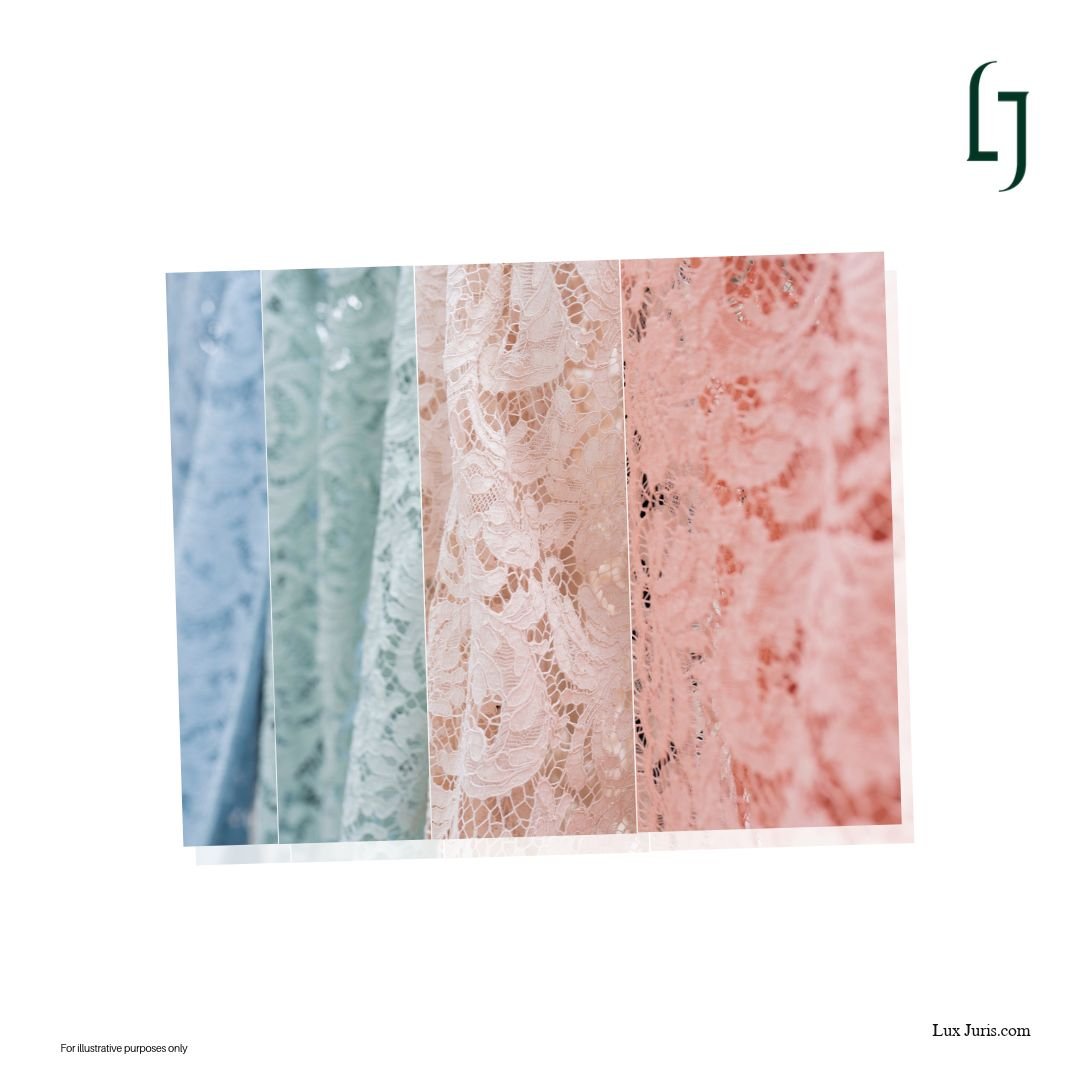
Flowers and leaves are familiar elements in lace-making, and no designer can claim exclusive rights over them. However, a floral lace design may still receive copyright protection if the particular way these elements are drawn, combined and arranged reflects original creative choices.
On 24 September 2026, the Paris Judicial Court found that Swedish fashion retailer NA-KD had infringed copyright in a lace design commercialised by French manufacturer Dentelle Sophie Hallette. The lace used in eight NA-KD garments reproduced the original features of the design so closely that the court described it as a direct copy.
Sophie Hallette sought €450,000 for copyright infringement and a further €200,000 for economic parasitism. Although the court found infringement, it awarded €25,000 in provisional damages and rejected the separate parasitism claim.
Background
Dentelle Sophie Hallette manufactures lace and tulle for the fashion industry, including ready-to-wear clothing and lingerie. The dispute concerned a floral lace design identified as reference 970120, consisting of two different floral patterns repeated in alternating vertical lines across the fabric.
Each pattern contained flowers and foliage with different shapes, proportions and decorative details. Their arrangement, together with variations in weaving and transparency, created a continuous floral composition.
NA-KD sold several garments made from lace that Sophie Hallette believed reproduced its design. The products included three mini dresses in white, black and light blue, two cardigans in black and white, a white maxi dress and two midi skirts in white and black. They were offered through NA-KD’s website and the Zalando marketplace.
On 30 December 2022, Sophie Hallette arranged for an official record of an online purchase from NA-KD. After examining the garments, it sent a formal notice on 20 February 2023, demanding that NA-KD stop selling the products and provide information about their production and distribution.
Further investigations in April 2023 established that six of the eight garments were also offered through Zalando. Sophie Hallette commenced proceedings before the Paris Judicial Court on 19 June 2023, alleging copyright infringement and economic parasitism.
The proceedings were later interrupted following the opening of restructuring proceedings involving NA-KD in Sweden. The French proceedings resumed after Sophie Hallette informed the court that NA-KD was no longer subject to those proceedings.
Was the lace design original?
NA-KD challenged the originality of Sophie Hallette’s design, arguing that it relied on features commonly found in traditional lace-making.
It maintained that flowers, leaves, repeated patterns, alternating arrangements and the contrast between dense and open spaces were established characteristics of guipure-style lace. To support its argument, NA-KD submitted historical examples, including a Balmain design from 1954 and a Nina Ricci design from 1957, together with a report from a lace specialist.
Sophie Hallette did not claim copyright over floral lace generally. Instead, it argued that originality arose from the particular combination of elements within its design, including the shapes and proportions of the flowers, the arrangement of the foliage, the alternation of the two patterns and the contrasts created by different weaving textures.
The court examined these characteristics under French copyright law and the principles set out by the Court of Justice of the European Union in its December 2025 judgment in Mio/konektra.
Copyright protection requires a work to reflect the author’s personality through free and creative choices. Features dictated by technical requirements do not establish originality merely because they involve skill or effort. Similarly, the use of familiar elements is not enough unless their particular treatment or combination reflects creative choices.
The court also explained that originality may arise from a combination of known elements, provided that the claimed combination is sufficiently precise and does not give its owner exclusive rights over an entire style or category of design.
In this case, Sophie Hallette identified two floral compositions, each with its own arrangement of flowers and leaves. One contained a flower with seven irregular petals and foliage extending above it. The other contained a more elaborate flower with several layers of petals, surrounded by leaves and smaller floral elements.
These compositions were repeated in alternating vertical lines. The court considered the proportions between the flowers and leaves, the positioning of the foliage, the movement created by the repeated patterns and the balance between dense and transparent areas.
It accepted that many individual features were common in traditional lace. However, the historical examples submitted by NA-KD did not reproduce the particular combination found in Sophie Hallette’s design.
The court also examined NA-KD’s expert report, which connected many of the design’s characteristics to established production techniques. It considered that the report placed too much emphasis on the manufacturing process and did not sufficiently account for the creative choices involved in drawing and arranging the floral elements.
The court preferred the evidence of a fashion and textile expert who explained that the use of machinery did not remove the possibility of originality in a lace design.
It concluded that the particular combination of flowers, foliage, proportions, textures and repeated arrangements reflected original creative choices and qualified for copyright protection.
The finding did not extend copyright protection to floral motifs or traditional lace-making techniques generally. It concerned the particular composition of the design.
Did Sophie Hallette hold the copyright?
NA-KD also questioned Sophie Hallette’s entitlement to enforce copyright because the design had originally been commercialised by another manufacturer.
Riechers Marescot had sold the lace from 2008 under reference 78184. Sophie Hallette began selling it under reference 970120 in 2012, following an internal reorganisation.
NA-KD argued that Sophie Hallette had not adequately established how the copyright had been transferred between the companies.
Under French law, a company cannot be the original author of a work, as authorship belongs to a natural person. However, a company that openly and consistently commercialises an identifiable work under its own name, without a competing claim from the author, may benefit from a rebuttable presumption that it holds the relevant economic rights against an alleged infringer.
Sophie Hallette submitted historical invoices, fabric samples, a digital timestamp, commercial records and dated publications showing how the design had been sold.
Although the records contained different product references, the court found sufficient evidence connecting the earlier design sold by Riechers Marescot with the one subsequently commercialised by Sophie Hallette.
The documents also established that Sophie Hallette had sold the design under its own name from 2012 through the period of the alleged infringement.
As no competing claim had been established, the court held that Sophie Hallette benefited from the presumption of copyright ownership. It was therefore entitled to enforce the rights without having to prove the complete creative history of the design or the precise circumstances in which the rights had been transferred.
Did NA-KD reproduce the protected design?
Having recognised copyright protection, the court compared Sophie Hallette’s design with the lace used in NA-KD’s eight garments.
NA-KD argued that the fabrics were different in several respects. It pointed to variations in the shapes and proportions of the floral elements, the thickness of their outlines, the density of the weave and the transparency of particular sections.
It also argued that only a very close reproduction of the original characteristics could amount to infringement and maintained that its garments did not meet that standard.
The court explained that copyright infringement is assessed by examining similarities in protected characteristics, rather than simply identifying differences between two works. However, similarities arising only from the use of a common style or category of design are not sufficient.
The comparison showed that NA-KD’s lace reproduced the two floral compositions, their particular arrangement, the proportions between flowers and foliage, the movement created by the leaves and the alternation of the patterns.
The court also considered the differences in manufacturing techniques.
Sophie Hallette’s lace was produced using traditional Leavers looms, while NA-KD’s fabric was made using modern knitting machinery. The different methods explained some variations in the proportions, thickness and appearance of the finished lace. However, the court found that these differences did not alter the underlying structure of the floral design.
The same combination of protected features remained present in NA-KD’s fabrics, despite variations in texture and production. The court therefore found that all eight garments reproduced Sophie Hallette’s original lace design without authorisation, establishing copyright infringement.
The finding concerned the lace pattern incorporated into the garments, rather than the overall shapes of the dresses, cardigans or skirts. NA-KD had not needed to reproduce a finished Sophie Hallette garment for infringement to arise.
Why were the damages limited?
Sophie Hallette sought €300,000 for commercial harm and €150,000 for moral damage arising from the infringement.
It argued that NA-KD had benefited financially from selling the garments while reducing the commercial value of its lace design.
To estimate NA-KD’s profits, Sophie Hallette calculated approximately 5,600 infringing garments offered through NA-KD’s website and another 3,600 through Zalando. It estimated profits of approximately €127,600 and €118,900 from the respective platforms.
But, the court found that these figures were based on assumptions about the number of sizes in which the garments were available, rather than evidence of actual sales.
Sophie Hallette had not established the number of products sold, the remaining stock, the revenue earned or NA-KD’s actual profit margins. The company also relied on an accountant’s statement showing expenditure of approximately €1.08 million in 2020 and 2021 for bringing 33 lace designs into production.
The court found that these figures did not identify costs attributable to the particular design involved in the dispute. It also observed that Riechers Marescot had originally created and commercialised the design, meaning Sophie Hallette could not claim to have incurred its original development costs. Nor had Sophie Hallette demonstrated a decrease in sales of the design caused by NA-KD’s conduct.
Regarding moral harm, Sophie Hallette argued that reproducing its lace in inexpensive garments widely promoted online diminished the value and reputation associated with its work.
The court accepted that the sale and promotion of these garments, including their visibility on social media, contributed to making the design more commonplace. However, it also observed that the design had been commercially exploited since at least 2008, which itself contributed to its familiarity.
Given the limited evidence of economic and moral harm, and the absence of reliable information about NA-KD’s profits, the court awarded €25,000 in provisional damages.
It also ordered NA-KD to provide information about its lace supplier, purchasing records, sales in France and profit margins relating to the eight garments.
This disclosure was necessary because NA-KD had not provided sufficient commercial information from which Sophie Hallette could assess the financial consequences of the infringement.
Why did the economic parasitism claim fail?
Sophie Hallette separately sought €200,000 for economic parasitism, arguing that NA-KD had improperly benefited from the value of its lace design, specialist knowledge and reputation.
The company referred to the use of its lace by prestigious fashion houses, including Valentino and Chanel, and maintained that NA-KD had gained a commercial advantage without making comparable investments.
Under French law, economic parasitism concerns a business improperly benefiting from another business’s efforts, knowledge, reputation or investment.
The court found that Sophie Hallette relied on the same copying already established under its copyright claim, without demonstrating separate harm. It also considered that the evidence did not sufficiently establish the individual commercial reputation or economic value of the particular lace design.
Although Sophie Hallette had a recognised position in the lace industry, the court found that its broader reputation did not establish the specific value claimed for this design.
The design had also been created and first sold by Riechers Marescot. Sophie Hallette had not demonstrated that its subsequent investments had given the design an independently identifiable economic value from which NA-KD had improperly benefited.
The court therefore rejected the economic parasitism claim.
Decision
On 24 September 2026, the Paris Judicial Court held that Sophie Hallette’s floral lace design was original and protected by copyright. It found that NA-KD had infringed those rights by offering and selling eight garments whose lace reproduced the design’s protected characteristics.
The court ordered NA-KD to stop using the infringing design within 30 days of service of the judgment. Failure to comply would result in a penalty of €200 per day for up to 180 days.
NA-KD was also ordered to destroy its remaining stock of the infringing garments at its own expense and disclose the relevant supplier, purchase and sales information.
The court awarded Sophie Hallette €25,000 in provisional damages and a further €25,000 towards legal costs, together with the applicable court costs.
The separate economic parasitism claim and the request to publish the judgment were rejected.
The judgment was delivered at first instance and was provisionally enforceable.
Consequences
The decision distinguishes between the familiar elements of traditional lace and the particular creative choices that may qualify a textile design for copyright protection.
Flowers, leaves, repeated patterns and established lace-making techniques remain available for designers to use. However, a particular arrangement of those elements may be protected where it reflects original creative choices that can be identified and explained.
The court’s comparison also shows that a difference in manufacturing technique does not necessarily prevent infringement. Although NA-KD used different machinery, the resulting fabrics reproduced the protected floral composition.
For textile designers and fashion brands, the ruling is relevant beyond the copying of finished garments. The design of a fabric may be protected independently of the clothing in which it is used, and sourcing a textile from another manufacturer does not remove the need to consider whether its pattern reproduces an existing protected work.
The judgment also demonstrates the importance of documentary evidence. Sophie Hallette established its entitlement to enforce copyright through historical invoices, samples and records connecting the design’s earlier commercial history with its own sales.
Its success was more limited when the court considered compensation and economic parasitism. Although infringement was established, the company could not sufficiently demonstrate the sales, losses and separate economic value on which its broader claims depended.
The ruling therefore recognises copyright protection in a particular floral lace composition without extending that protection to the traditional motifs and techniques from which it was created.
Source