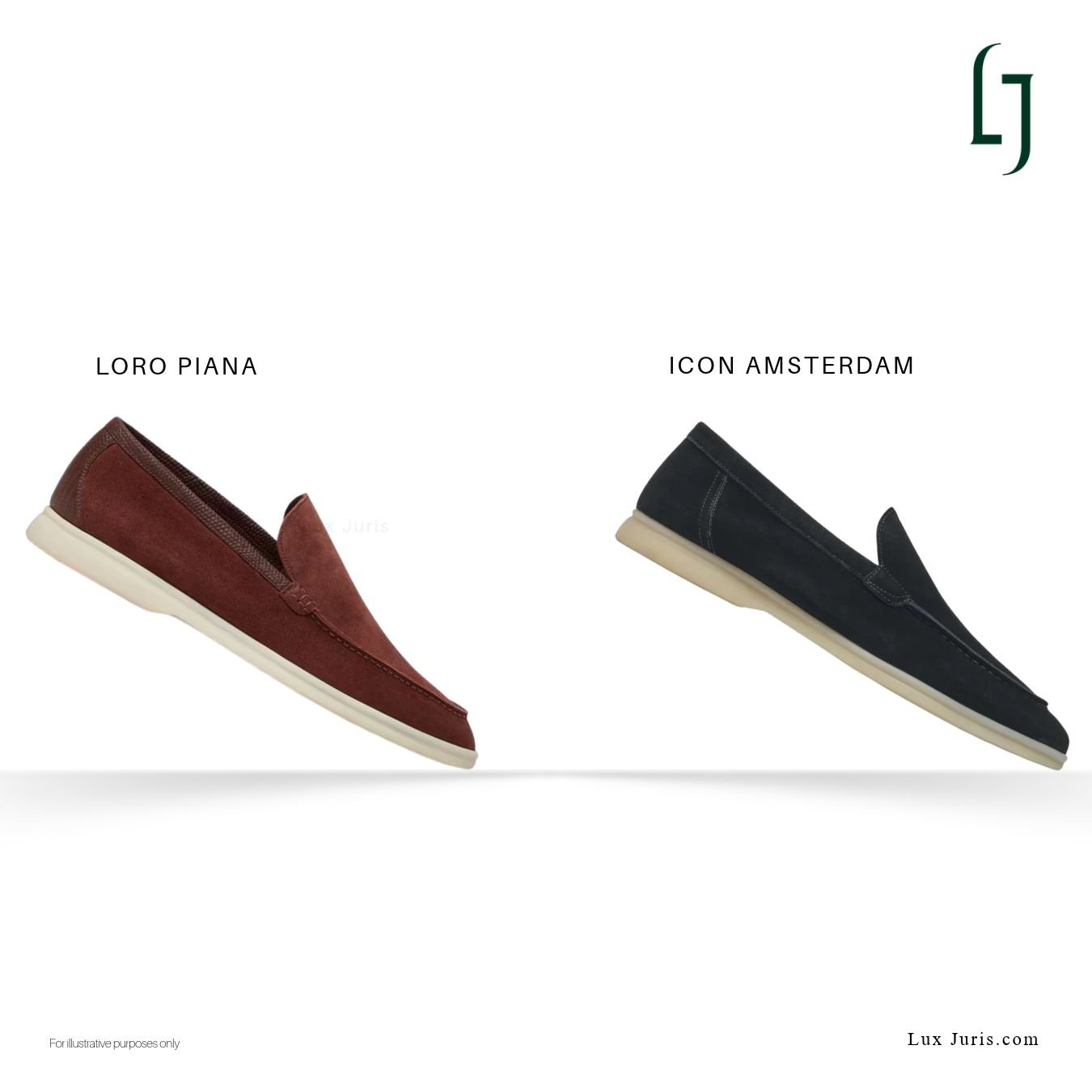
Loro Piana sought to stop ICON Amsterdam from selling shoes with soles that closely resembled its own. It claimed copyright in the white sole used in its “white sole collection”, pointing to its groove, heel, arch and material as the result of free and creative choices.
On 4 November 2026, the District Court of Midden-Nederland rejected its claims in preliminary proceedings. Loro Piana had not sufficiently explained why those choices were creative. Although the resemblance was undisputed, the company first had to establish that its design qualified for copyright protection.
The case
According to Loro Piana, it first used the sole sometime between 2002 and 2005. It argued that ICON’s shoes, sold as “The Classic”, had a similar sole and infringed its copyright. It asked the court to stop their sale, together with related relief.
ICON disputed that the sole was protected by copyright and denied infringement. The court therefore first examined whether Loro Piana’s design qualified for protection. It applied Dutch law under Article 5 of the Berne Convention. The claim concerned the sole rather than the shoe as a whole.
The sole’s design
Loro Piana relied on four features to support its claim.
The first was a long, narrow, horizontal, semicircular groove running around the entire circumference of the sole, five millimetres below its upper edge. It visually divided the sole into two parts. The second was a slightly convex heel that did not stand perpendicular to the ground. The third was a low arch shaped like a flat, low scalene triangle. The fourth was the slightly translucent, off-white material, which provided high friction without being rough.
The court found that Loro Piana had not sufficiently explained why these choices were creative or unique. Its explanation remained general. It had not made clear which specific choices the designer had made or why they gave the design its own character.
A designer’s choices may be free without being creative. Describing a groove by its width and position, or a heel by its curve, identifies what the designer produced. It does not, by itself, explain the creative expression behind the design.
Luxury and copyright
Loro Piana also argued that designing an extremely exclusive, high-end fashion product necessarily involved the maker’s aesthetic preferences and was therefore creative.
The court disagreed. That argument effectively treated every free choice as creative because a designer aimed to make the product as beautiful as possible. According to the Court of Justice, aesthetic appeal could play no role in assessing originality.
The court referred to the Court of Justice’s judgment in Mio and Konektra, delivered on 4 December 2025. Copyright requires free and creative choices that express the maker’s personality and give the object a unique character.
The court also considered earlier designs submitted by ICON, dating from before 2002. In light of that material, as well as Loro Piana’s explanation, it found the claimed creativity insufficiently plausible. The judgment did not set out a detailed comparison with each earlier design.
Materials and style
The court observed that the exclusive character of Loro Piana’s products often came from its luxurious, high-quality materials. Those qualities did not, in themselves, form part of a product’s design. Loro Piana had not sufficiently explained why this case was different.
Its reliance on an understated luxury style also failed. Features belonging to a style were not themselves protected by copyright. General references to the brand’s approach and product quality could not replace an explanation of the creativity in this particular sole.
The court’s decision
The court found that Loro Piana had not sufficiently established, at this preliminary stage, that its white sole qualified for copyright protection. All its claims depended on that protection, so the court rejected them.
It therefore did not need to decide whether ICON had infringed copyright. Nor did it decide whether Loro Piana owned any copyright in the sole or which law governed ownership. Loro Piana was ordered to pay €18,722.29 in costs, including €17,798.29 in lawyers’ fees. It had not disputed the amount of those fees.
The court was assessing whether Loro Piana’s claims were likely enough to succeed in proceedings on the merits to justify granting relief before those proceedings.
The decision shows that describing a design’s features did not establish originality here. A party claiming copyright may show that a designer was free to choose a shape, curve or material, but must still explain why those choices reflect original creative expression. Similarity between two products cannot establish that the design claimed to have been copied is protected by copyright.
Source: