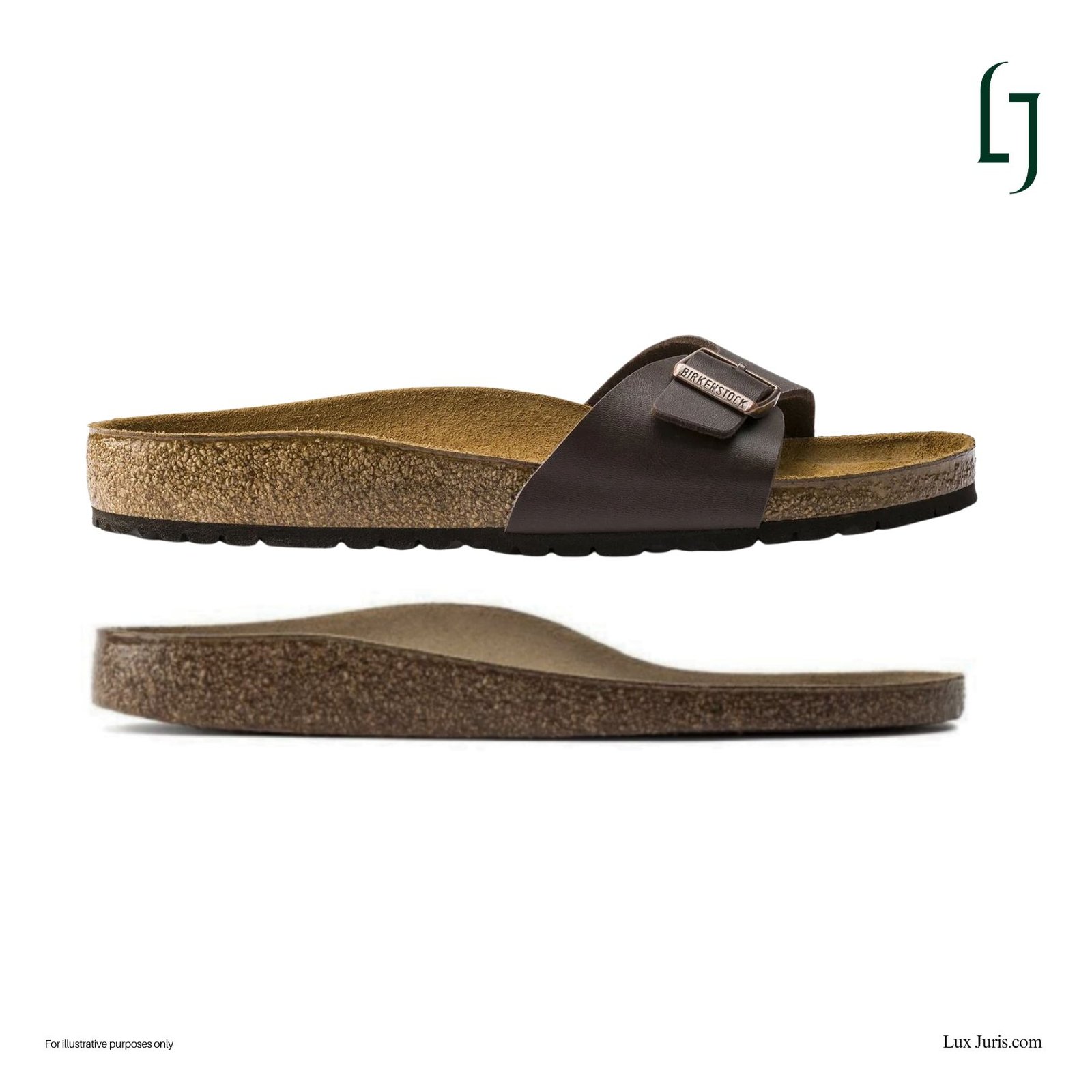
A single protected feature can support a copyright claim against several lookalike products. In Birkenstock v. Lidl, a Dutch court found that five Lidl sandal models had reproduced the same protected feature of Birkenstock’s lower part.
On 23 September 2026, the District Court of Gelderland ruled on a dispute over Lidl sandals resembling Birkenstock’s Madrid, Arizona, Florida, Boston and Gizeh models. Birkenstock argued that copyright protected the lower part used across the sandals and also the individual uppers of the five models. As a fallback, it relied on slaafse nabootsing, or slavish imitation, a Dutch doctrine that can make product imitation unlawful in certain circumstances.
The court did not find copyright protection in most of the features Birkenstock relied on. Many were considered functional, ergonomic, ordinary or not creative enough. It found copyright in one element of the lower part used across the five sandals and, separately, one element of the Madrid upper. That limited finding was still enough for the court to hold that Lidl had infringed Birkenstock’s rights.
Where function ended and copyright began
The main difficulty for Birkenstock was that many features of its sandals serve a practical purpose. The lower part follows the shape of the foot and includes features intended to support the heel, arch and toes.
The court treated the sandals as works of applied art and applied the copyright test set out by the Court of Justice of the European Union in Mio and Konektra. It examined which features reflected Karl Birkenstock’s free and creative choices and which were shaped by technical or ergonomic needs.
The court found that much of the lower part followed the anatomy of the foot. This included the depression at the heel, the raised middle section and the shaped area beneath the toes. It also treated the gently changing outline of the footbed as functional.
The visible layers of cork, velour and sole did not show sufficient creativity. Leaving the cork exposed at the side was a free choice, but the court did not find it creative enough for copyright protection.
The court reached a different conclusion about the lower part’s side profile. Viewed from the side, it forms a wall that is higher at the heel and descends towards the front in a subtle curve. The judgment calls this the wand, or side wall.
The court found that the particular change in height and the way it was shaped were not required for the sandal to function. They reflected free and creative choices, so this feature qualified for copyright protection.
The court therefore protected this specific feature of the lower part, rather than the footbed or sandal as a whole.
Why only the Madrid upper was protected
Birkenstock also relied on the individual uppers of the five sandals, but the result was different from model to model.
The Madrid was the only upper in which the court found a protected element. Birkenstock relied on its single-strap construction, the width and arrangement of its bands, its minimalist appearance, the absence of visible stitching and its rectangular buckle. Most of those features were rejected because they were functional, common or part of a general minimalist style rather than sufficiently creative expression.
One arrangement was different. The Madrid has a clearly narrower strap, about two centimetres wide, running over a visibly wider band of about five centimetres. The court considered the contrast between those widths, and the way the two parts were arranged, to be creative enough for copyright protection.
The Arizona did not receive the same protection. Although it developed from the Madrid, the difference between the widths of its straps was much less pronounced. The court considered that relationship too ordinary to amount to a creative choice, while the other features Birkenstock relied on were functional, ergonomic or not creative enough.
The Florida and Boston also failed to obtain protection for their uppers, but for different reasons. The Florida’s three-strap construction was a free choice, but not one the court considered sufficiently creative. The Boston’s closed upper, curved form, foot opening, buckle and attachment to the lower part were treated as either functional or not sufficiently original.
The Gizeh raised a different issue. Its upper had previously been covered by a Benelux design registration. Under the law that applied at the time, the related copyright expired when the design right ended because the required declaration preserving the copyright had not been filed. The court therefore held that copyright in the Gizeh upper had expired in 1998.
Of the five uppers, only one specific feature of the Madrid was therefore protected.
Why narrow protection was still enough
Having identified what was protected, the court then turned to infringement.
Following Mio and Konektra, the question was whether the protected creative elements had been recognisably reproduced. The court did not treat the overall visual impression of the two products as decisive for copyright.
When it examined the physical sandals submitted in the case, the court found that Lidl’s lower parts reproduced the protected wall profile. Lidl’s versions were somewhat flatter overall, but they still had a higher rear section that descended through a visible wave towards a flatter front.
The court considered that enough to amount to a recognisable reproduction of the protected element.
The same conclusion applied to the Lidl sandal corresponding to the Boston, even though more of the lower part was covered by the upper. The protected profile was still visible. Because the same protected feature appeared in the lower part used across all five Birkenstock models, the court found infringement across all five corresponding Lidl sandals.
The Madrid led to a second finding of infringement. Lidl had also reproduced the protected narrow-over-wide strap arrangement. Lidl argued that its upper strap was more than one centimetre wider than Birkenstock’s. The court accepted that this was a difference, but found that it did not prevent the protected arrangement from being recognisably reproduced.
This is the central point of the copyright part of the judgment. Birkenstock did not need protection for every feature of each sandal. One protected element common to the lower part was enough to reach all five Lidl products once that element had been copied in a recognisable way.
Why slavish imitation failed
Birkenstock also relied on slaafse nabootsing, or slavish imitation, for the Arizona, Florida, Boston and Gizeh uppers that did not succeed under copyright.
Under Dutch law, copying a product that is not protected by an exclusive IP right is generally allowed. Slaafse nabootsing can make that copying unlawful where the original product has an eigen gezicht op de markt, meaning a distinct appearance that sets it apart from similar products in the market, and the imitation creates avoidable confusion.
The court found that Birkenstock had not established this strongly enough. It stressed that popularity, reputation and market share do not themselves show an eigen gezicht op de markt. What matters is whether the appearance of the product itself stands out from comparable products in the relevant market.
That was difficult for Birkenstock because many similar sandals were already present in the Dutch market. The court also noted that Birkenstock had sent infringement letters from 2015 onwards but had not pursued those matters further.
In the court’s view, this had allowed a wide range of comparable sandals to enter and remain in the market. That created a broad field of similar designs in which any formerly distinctive appearance had already been diluted.
The slaafse nabootsing claim therefore failed even though the copyright claim succeeded.
What the court ordered
The court ordered Lidl Nederland and Rieg & Niedermayer to stop infringing Birkenstock’s copyright in the Netherlands, including by stopping the offer and sale of sandals that reproduce the protected lower-part element and, in the Madrid, the protected upper element.
The claims against Lidl Stiftung were dismissed because Birkenstock had not sufficiently shown that it had carried out the relevant infringing acts in the Netherlands.
If Lidl Nederland or Rieg & Niedermayer fails to comply with the order, each can be required to pay €5,000 for every day, or part of a day, that the infringement continues, up to a maximum of €250,000.
They must also provide Birkenstock with information about manufacture, orders, stock and sales from 7 November 2023 onwards, together with information about suppliers and professional customers. The precise starting date of the infringement had not been established, so the court selected a date six months before Birkenstock’s 7 May 2024 demand letter.
Failure to provide the required information can lead to a further payment of €1,000 per day, capped at €100,000.
The court also held Lidl Nederland and Rieg & Niedermayer responsible for the financial loss caused by the infringement, but it did not decide the amount. That will be determined later in separate proceedings dealing with damages.
Why the decision matters
The importance of the decision lies in how narrowly the court defined the protected elements and how far that protection still reached. The court found copyright in one element of the lower part used across the five sandals and one separate element of the Madrid upper. Most of the other features Birkenstock relied on were treated as functional, ergonomic, ordinary or not creative enough for protection.
Even so, that narrow protection reached all five Lidl sandal types because the protected lower-part feature was found to have been copied in a recognisable way across them. The Madrid also involved a second infringement finding because Lidl had reproduced the protected strap arrangement in the upper.
The result was different for slaafse nabootsing. For the Arizona, Florida, Boston and Gizeh uppers, Birkenstock still had to show an eigen gezicht op de markt. The court found that it had not done so strongly enough, particularly because a wide range of similar sandals had already entered and remained in the market.
The case therefore shows two different limits of product protection. Copyright can attach to a specific creative feature even where much of a product is functional, and that narrow right can still have significant commercial effect if the same feature appears across several products. But where copyright does not protect the relevant features, fame and strong sales alone do not make imitation unlawful. The product must still satisfy the separate requirements of slaafse nabootsing.