When you buy a scarf, do you gain the right to use its design in a product you plan to sell?
A decision of the Paris Judicial Court examines the legal limits of “upcycling” in fashion when protected designs and trademarks are involved.
The case was brought by Hermès, the luxury house responsible for producing many of the brand’s leather goods and accessories, among the most popular of which are the Birkin and Kelly bags. Hermès owns the word trademark “Hermès”, originally registered in 1936 for clothing and fashion accessories. Since 1937, the house has also produced silk scarves featuring printed designs created by artists whose rights were assigned to Hermès.
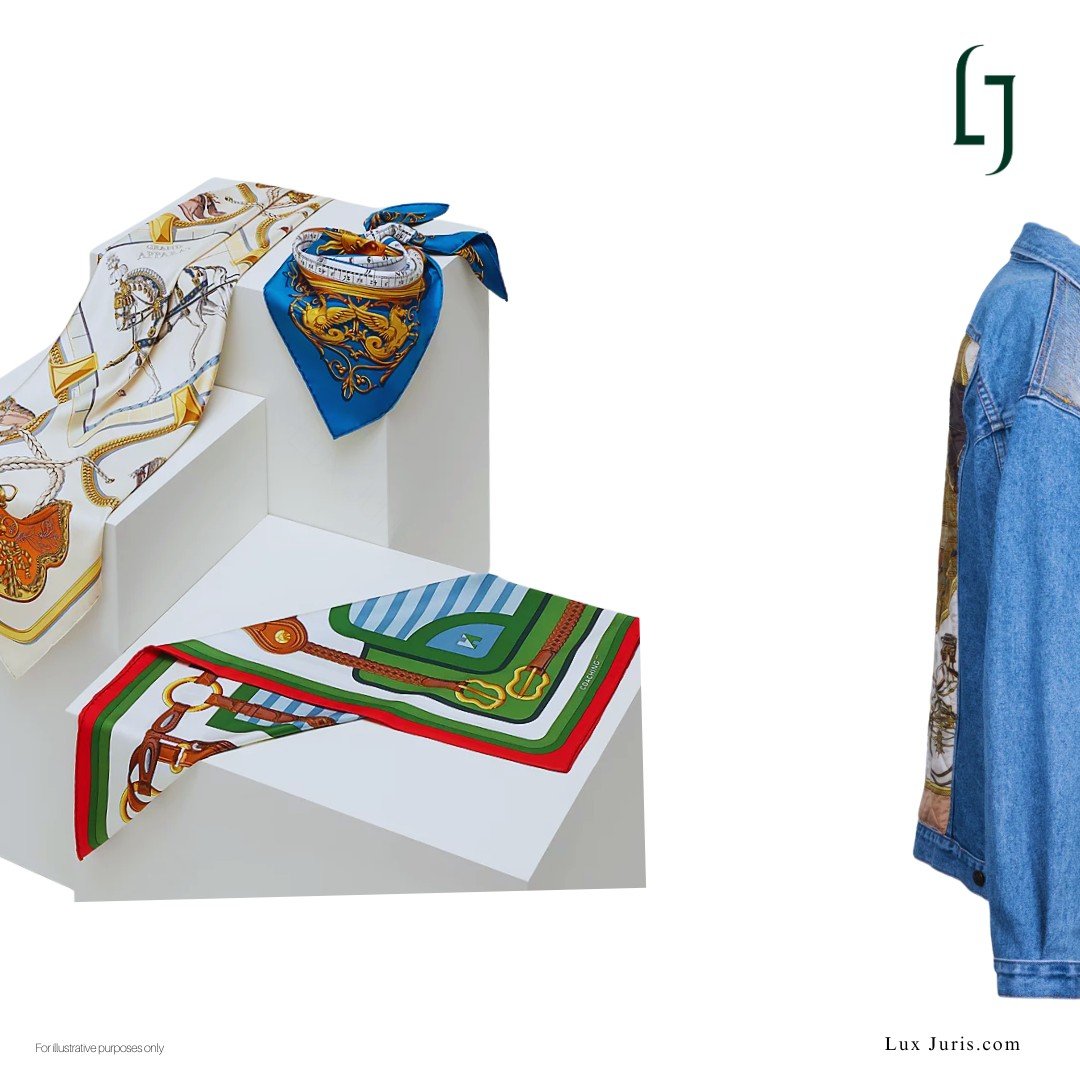
The defendants, Atelier R&C and Maison R&C, a design project centred on reworking existing garments. The concept involved taking vintage Levi’s denim jackets and customising them with decorative patches cut from Hermès silk scarves, turning each jacket into a reworked piece.
The jackets were presented online and promoted through social media, and the concept also attracted attention in fashion press coverage. Clients could select different scarf designs and customise the placement and style of the patches.
Hermès objected to this practice and sent a cease and desist letter in August 2021. When the activity continued, the company brought legal proceedings alleging copyright infringement, trademark infringement, and related unlawful commercial conduct.
Jackets made with Hermès scarves
Evidence presented before the court showed that the defendants had produced and sold several denim jackets incorporating pieces of Hermès scarves.
Fragments of the scarves were sewn into visible areas of the jackets, including the collar, the back panel, and the cuffs. The scarf designs confirmed as used included well known Hermès patterns: “Astrologie,” “Gaucho,” and “Brides de Gala.” In certain cases, the patches also contained the word “Hermès” woven into the fabric of the original scarf.
Hermès had never authorised the cutting, transformation, or resale of these scarves as part of another commercial product.
The defendants argued that the scarves had been purchased on the second hand market and were therefore lawfully acquired. They also presented their work as an environmentally responsible upcycling project intended to extend the life of existing products.
The court did not accept these arguments.
Copyright protection of the scarf designs
The court first examined whether the Hermès scarf designs were protected by copyright.
Hermès produced evidence showing that the designs were created by artists and that the company had obtained the relevant rights through contracts. The judges accepted that the scarf patterns qualified as original works protected by copyright.
By cutting the scarves and incorporating the designs into jackets, the defendants reproduced and displayed these works in a new commercial product without authorisation.
The defendants attempted to rely on artistic freedom and environmental considerations. They argued that their project was part of a sustainable approach to fashion and involved a creative transformation of existing materials.
The court was not convinced. The jackets were produced and sold as part of a commercial activity, and the transformation did not demonstrate an independent artistic purpose beyond decorative use.
The scarves themselves also continued to have economic value on the second hand market. They were not damaged or abandoned items with no remaining commercial use. The court therefore concluded that the unauthorised use of the designs constituted copyright infringement.
Trademark infringement and the use of “Hermès”
The court also examined the use of the Hermès trademark.
First, the word “Hermès” appeared directly on some of the scarf fragments sewn into the jackets. Second, the name was used in online promotion, including on the Maison R&C website and through hashtags such as “#Hermes” on Instagram.
The defendants argued that trademark rights had been exhausted because the scarves were genuine products that had already been placed on the market.
The court rejected this reasoning. Trademark exhaustion allows the resale of genuine goods in their original condition. However, the position changes when the product is altered and incorporated into a different commercial item.
In this case, the scarves were cut and transformed into decorative elements for jackets sold under another brand. Because the word “Hermès” remained visible on the patches, consumers could perceive it as indicating a connection with the jackets themselves.
The online use of the name and hashtags also promoted the products and helped direct consumers to them. The court therefore held that these uses amounted to trademark infringement.
The court’s decision
The court found the defendants liable for both copyright infringement and trademark infringement.
They were ordered to stop producing, selling, or displaying jackets containing pieces of Hermès scarves bearing the protected designs. They were also prohibited from using the terms “Hermès” or “#Hermes” in connection with these products online.
The defendants were ordered to pay €10,000 to Hermès Sellier for copyright infringement and €10,000 to Hermès International for trademark infringement. The court also awarded €1,500 for the unauthorised use of photographs taken from Hermès advertising campaigns.
Conclusion
When you buy a scarf, do you gain the right to use its design in a product you plan to sell?
Buying a scarf gives you ownership of the physical product, but it does not give you the right to use its protected design in a new product that you intend to sell.
The decision illustrates a clear limit for commercial upcycling.
Buying genuine products on the second hand market does not automatically give a business the right to cut them apart and incorporate protected designs or trademarks into new products for sale. When those elements remain visible and are used to promote a new item, intellectual property rights may still apply.
For designers working with luxury materials, the case shows that sustainability arguments do not remove the need to obtain permission when protected works and trademarks are involved.
Source: