Why “Waiting for My Birkin” Was Treated as Trademark Infringement
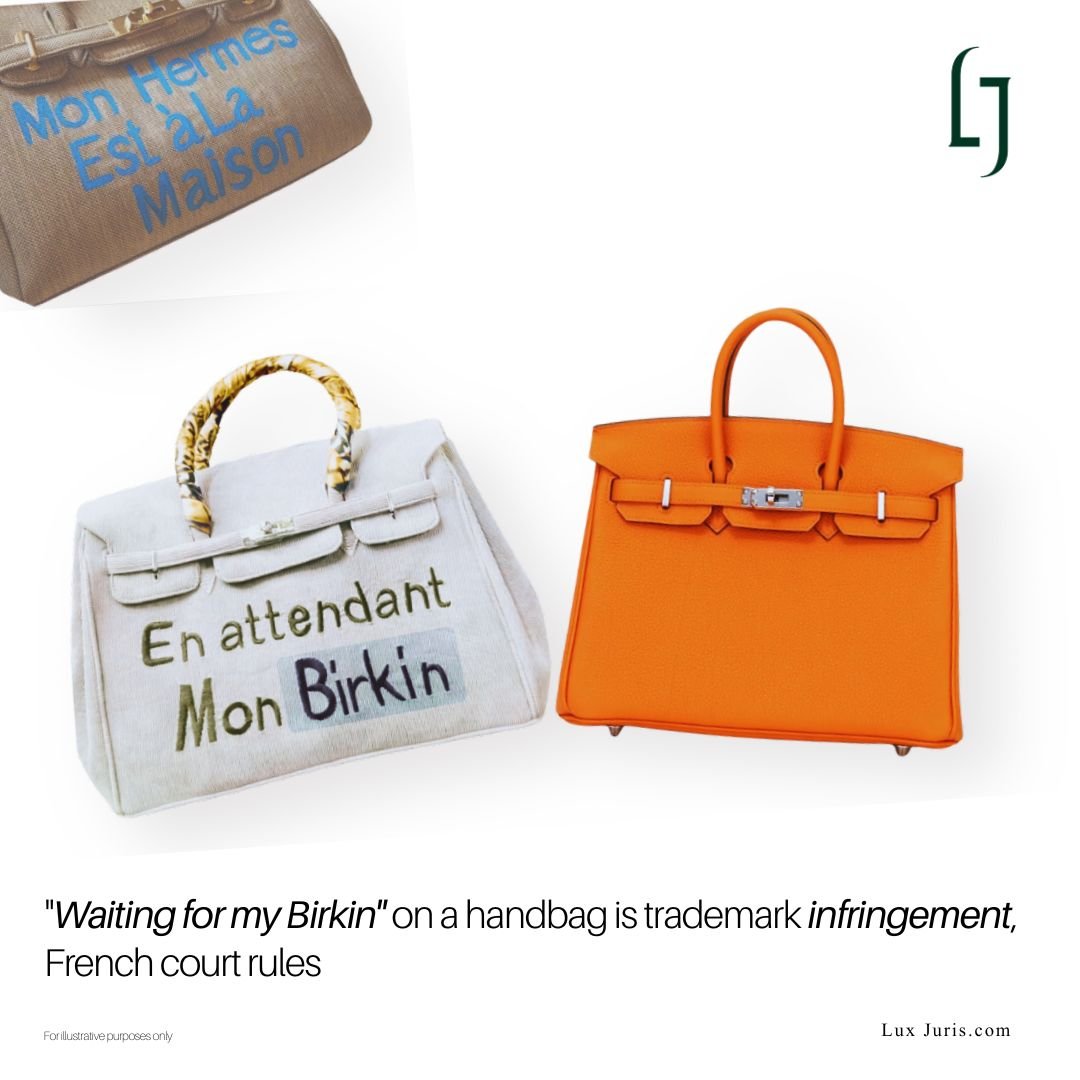
“En attendant mon Birkin”, translated as “Waiting for my Birkin”, appears at first reading as a light and self-aware phrase. In March 2026, the Court of Appeal of Versailles examined whether such wording, printed on handbags, remains harmless humour or amounts to trademark infringement. The answer is direct and consistent throughout the ruling. “Waiting for my Birkin” was not treated as a joke, but as trademark use on goods.
The decision was issued by the Court of Appeal of Versailles (Cour d’appel de Versailles), reviewing a judgment of the Judicial Court of Nanterre (Tribunal judiciaire de Nanterre). The case concerned handbags sold with the phrases “En attendant mon Birkin” and “Mon Hermès est à la maison”, translated as “My Hermès is at home”, both referencing registered word marks owned by Hermès.
The background before the French courts
The dispute began when Hermès identified that a retailer, Sherine Orient, was selling handbags bearing these phrases, both in a physical boutique and on Instagram. The products directly incorporated the names “Birkin” and “Hermès”, which are protected for handbags and related goods.
Hermès issued formal notices in September and October 2022. The products remained on sale. Bailiff reports confirmed continued commercialisation, leading Hermès to initiate proceedings before the Judicial Court of Nanterre in March 2023.
At first instance, the court ruled partly in favour of Hermès. It recognised copyright infringement relating to the Kelly and Birkin designs and found infringement of a three-dimensional trademark. However, it rejected the claims based on the word marks BIRKIN and HERMÈS.
The reasoning was limited to form. The court held that “Birkin” and “Hermès” appeared within longer phrases and that these phrases should be assessed as complete expressions. On that basis, it found no identity between the signs used and the registered marks.
Hermès appealed.
The question on appeal
Before the Court of Appeal of Versailles, the issue was precise. Does placing a trademark inside a longer, humorous phrase remove its commercial role and avoid infringement?
By the time the appeal was heard, Sherine Orient had been dissolved and removed from the commercial register, meaning it was no longer operating as a company. It did not appear in the proceedings, and the court ruled by default.
The absence of the defendant did not simplify the legal question. The court still had to determine how these phrases function when used on goods.
The court’s reasoning
The Court of Appeal did not follow the approach taken at first instance. Instead of treating the phrases as complete units, it examined how they would be understood in the market.
It began with the mark “Birkin”, noting that it is widely known in relation to handbags and retains what the judgment describes as its “pouvoir attractif”, meaning its ability to attract consumer attention.
From there, the conclusion was straightforward. A handbag printed with “En attendant mon Birkin” (“Waiting for my Birkin”) would be understood as referring to a genuine Birkin bag that the consumer does not yet own. The phrase does not create a new meaning. It depends entirely on the existence and desirability of the Birkin product.
The same reasoning applied to “Mon Hermès est à la maison” (“My Hermès is at home”). The phrase would be read as referring to an actual Hermès item, establishing a direct comparison between the product being sold and the brand’s goods.
In both cases, the court identified a clear link between the trademarks and handbags, which are identical to the goods covered by the registrations.
On the role of humour
The court addressed the tone of the phrases directly. It accepted that they carried humour and that consumers were unlikely to believe the handbags originated from Hermès.
This did not prevent infringement.
The reasoning shifts to commercial effect. The court found that the phrases were used to benefit from the reputation of the marks, described as “tirer parti de leur réputation”, meaning to take advantage of that reputation.
The phrases attract attention because they refer to well-known luxury products. That attention supports the sale of the handbags. In that sense, the marks are doing commercial work, regardless of the humorous tone.
Why adding words does not avoid infringement
A key part of the decision is its treatment of the argument that adding words changes the sign.
The first instance court had accepted that the phrases created something new. The Court of Appeal did not agree. It examined whether “Birkin” and “Hermès” remained clear and meaningful within the phrases. It found that they did.
The added wording does not change how the marks function. It frames the product by reference to the original branded goods.
The reasoning is practical. If adding words were enough, it would allow easy use of well-known trademarks within slogans to sell goods. The court addressed this directly by focusing on how the mark operates in the sale of the product.
Outcome and costs
The Court of Appeal of Versailles overturned the earlier ruling on the word mark claims. It held that the importation, display, offering for sale, and commercialisation of the handbags amounted to trademark infringement in France.
On costs, the court left the appeal costs with Hermès, which had withdrawn its financial and injunctive claims against the by-then dissolved defendant before judgment was handed down.
“Waiting for my Birkin” as trademark infringement
The case returns to its central point. “Waiting for my Birkin” was treated as trademark infringement because it was used to sell handbags.
The decision applies established principles in a direct way. A trademark does not lose its effect because it appears within a longer expression. A humorous tone does not remove its role in selling a product. When a phrase draws value from a well-known mark to market identical goods, it falls within infringement.
For brands, businesses, and designers, the outcome leaves little room for interpretation. “Waiting for my Birkin” is not just a phrase when placed on products. It functions as trademark use, and in this case, it was unlawful.
Source: