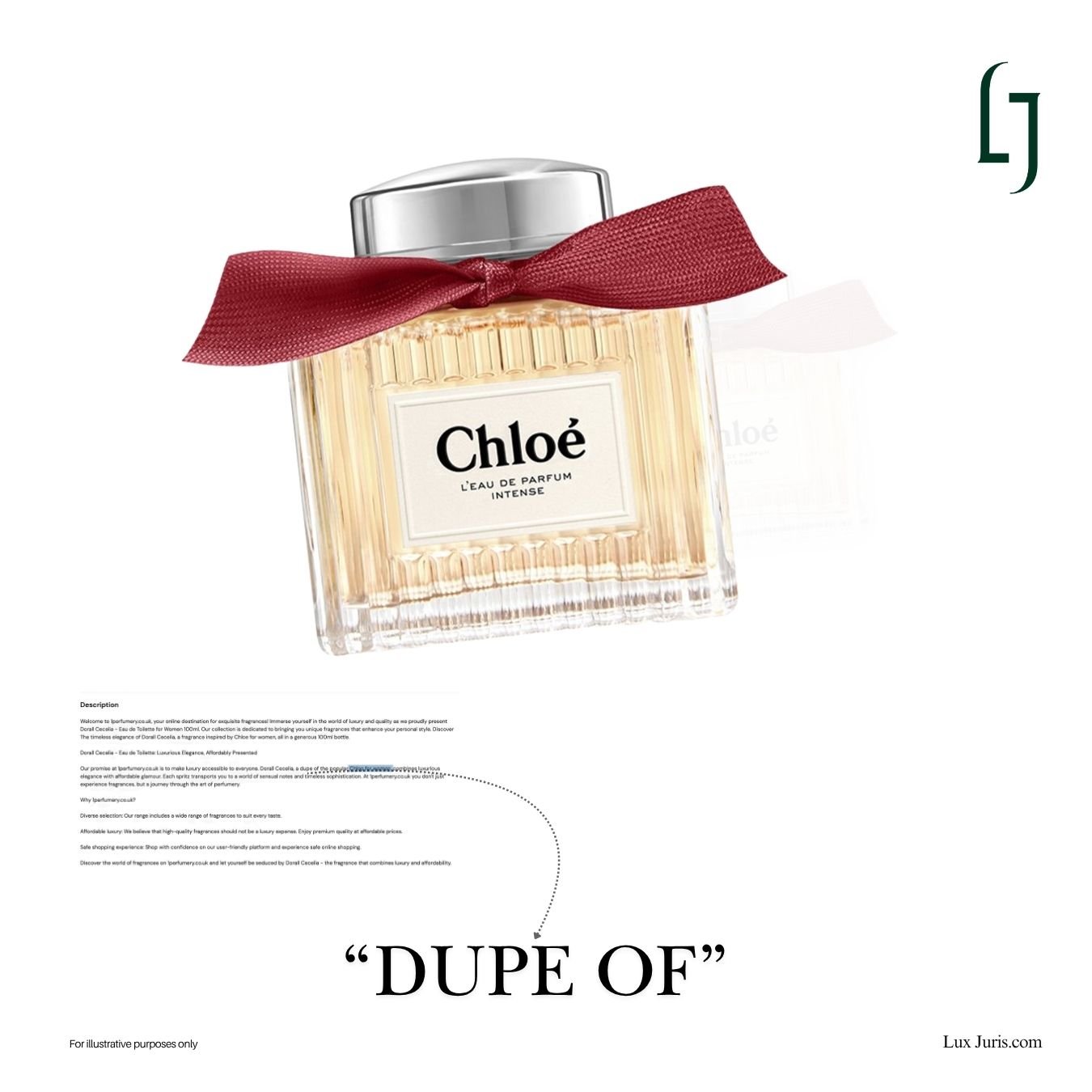
A perfume dupe does not need to carry the original brand’s trade mark on its bottle or packaging for trade mark issues to arise. A recent decision from the District Court of The Hague shows why the legal analysis may extend beyond the physical product to the way that product is offered, searched for and found online.
On 21 August 2026, the District Court of The Hague granted interim relief to Coty B.V. and Coty Beauty Germany GmbH against Europerfumery entities based in London and Warsaw. Europerfumery did not appear in the proceedings, so the judgment was given by default. That qualification matters because the court was not deciding the dispute after hearing competing arguments from both sides. It considered Coty’s reduced claims and, subject to certain limitations, found no basis to regard them as unlawful or unfounded.
Europerfumery did not appear, but the court could not simply give a default judgment without first considering whether the companies had been properly served. It could not confirm that either company had been formally served with the summons. Coty had attempted service on the London entity under the Hague Service Convention and on the Warsaw entity under the EU Service Regulation. It had also sent the documents by registered post and email and published notice in the Dutch Government Gazette. Even so, the court found that the usual formal service requirements had not been met.
The court could still proceed because both the Hague Service Convention and the EU Service Regulation allow urgent interim measures in certain cases even where formal service has not been confirmed. The court found it sufficiently likely that Europerfumery had received the summons in time because Coty had emailed it to the addresses listed on Europerfumery’s own websites and delivery had been completed. On that basis, the court concluded that Europerfumery had had an opportunity to respond and allowed the case to proceed in default.
The dispute went beyond the bottle
Coty’s case concerned three forms of alleged trade mark use on Europerfumery’s websites. It said that imitation perfumes were offered using the trade marks relied upon by Coty, that consumers could use search filters to search for perfumes associated with those marks and locate corresponding imitation versions, and that the same marks were also being used in the websites’ metadata. Coty further argued that Europerfumery could not successfully rely on the rules permitting comparative advertising.
The important point came when the court considered Coty’s request for disclosure. The judgment expressly records that Coty had not alleged that the imitation perfumes themselves, or their packaging, carried Coty’s trade marks. Even so, the court considered information about the commercial distribution of those products relevant where they had been offered using infringing signs on the websites.
That distinction is particularly important for the perfume dupe market because trade mark analysis can easily become concentrated on the physical product. Attention tends to fall on whether the bottle resembles the original, whether the packaging copies distinctive elements or whether the original brand name appears anywhere on the goods. Those questions remain important, but they do not necessarily capture the whole transaction.
A consumer may reach a dupe because the original perfume name appears in an offer. A search filter may allow the consumer to select the original fragrance and then locate an imitation version. The original mark may also appear in metadata that forms part of the digital structure through which the product is marketed. In that situation, the mark may be absent from the bottle while still playing a commercial role in bringing the consumer to the competing product.
The judgment does not establish that every use of a rival’s name in a search filter or in metadata is automatically infringing. Because Europerfumery did not appear, the court did not test that boundary against a contested defence.
Comparative advertising formed part of the case
Coty also challenged Europerfumery’s conduct as unlawful comparative advertising. The court prohibited Europerfumery from engaging in unlawful comparative advertising towards Coty in the Netherlands, but it did not grant the wider prohibition Coty had sought against every form of other unlawful conduct or unfair competition. The court considered that broader wording insufficiently specific for interim proceedings.
That limitation is important because the judgment does not say that every reference to another perfume is unlawful. Nor does the published decision specifically analyse expressions such as “inspired by”, “alternative to” or “dupe of”. Because Europerfumery did not appear, the court did not hear a developed defence explaining why any particular comparison should qualify as lawful comparative advertising.
The decision should therefore not be converted into a general rule that any reference to an original fragrance infringes. Its value is more precise. It shows that comparative advertising can sit alongside trade mark infringement arguments where a dupe business uses the original brand as part of the way an alternative product is presented, searched for or found.
The court’s orders
The court granted trade mark injunctions with different territorial scopes depending on the claimant, defendant and rights involved. Europerfumery London was prohibited from infringing certain EU trade marks of Coty across the European Union. Other EU trade mark injunctions were limited to the Netherlands, while the relevant Benelux trade mark injunction applied across the Benelux. Europerfumery was also prohibited from engaging in unlawful comparative advertising towards Coty in the Netherlands.
The injunctions were to take effect two days after service of the judgment and simultaneous transmission by email. The timing matters because the financial penalties attached to the orders were penalties for non-compliance, not an immediate monetary award arising simply because the judgment had been issued.
The court also ordered Europerfumery to provide information concerning the commercial chain behind the relevant imitation perfumes. That included suppliers, distributors, quantities supplied, business customers, quantities sold and remaining stock. The disclosure order was directed at identifying the scope of the relevant activity and assisting Coty in preventing further infringement.
Coty did not, however, obtain all the information it had requested. The court refused to order disclosure of turnover, profits and purchase and sale prices because it considered that information relevant principally to the calculation of damages or the surrender of profits. Those matters were not sufficiently urgent for determination through the interim procedure.
Customer disclosure was also narrowed. Europerfumery was required to identify business customers rather than consumers, and it was permitted to redact consumers’ personal data from the information provided. The court therefore drew a distinction between information needed to understand and stop the alleged infringement and information directed towards the later financial consequences of that conduct.
Penalties were attached to non-compliance with the court’s orders. Europerfumery could face €5,000 for each breach and €1,000 for every day, or part of a day, that a breach continued, subject to an overall maximum of €250,000. The €250,000 figure was therefore not an award of damages to Coty. It was the maximum amount that could become payable through penalties for failure to comply with the orders.
Coty did not obtain the rectification it wanted
The court also rejected Coty’s proposed rectification. Coty had sought a statement informing customers that the court had found trade mark infringement and misleading comparative advertising and that Europerfumery was neither affiliated with nor licensed by Coty.
The court considered the proposed wording insufficient because a rectification is intended to correct a mistaken impression among the relevant public. Merely announcing that a party has acted unlawfully does not necessarily achieve that purpose. The proposed statement did not identify the particular marks or products clearly enough to explain how the public had allegedly been misled and therefore did not adequately correct the relevant impression.
What the decision means for the dupe market
For brands monitoring perfume dupes, the practical lesson is that enforcement does not necessarily stop at the bottle. The product offer, search filters, metadata and comparative advertising may all form part of the relevant evidence. Where the original mark helps consumers locate, understand or select an alternative product, the digital sales route may become part of the trade mark analysis.
That may also change the way evidence is collected. Looking only at photographs of the product or its packaging may miss the more significant use. A brand may need to examine how the product is found, what happens when its own mark is entered into a search function, how filters are organised, what appears in metadata and how any comparison with the original product is presented.
For sellers, the reverse is equally important. A different bottle, different packaging and a different product name do not by themselves answer the legal question. The review should extend to the way the product is described, searched for, filtered, indexed and compared before the listing goes live. A dupe may be visually independent from the original product while the selling architecture continues to rely heavily on the original brand.
The published judgment does not identify the particular Coty brands or perfumes involved because those marks were listed in the summons but are not reproduced in the decision. Nor should a default interim judgment be treated as a definitive ruling on every form of perfume comparison or every dupe business model. Its significance is narrower, but still important: the absence of the original mark from the dupe does not necessarily mean the original mark is absent from the transaction. The trade mark issue may instead arise from the route through which the consumer is led to the dupe.
Source: