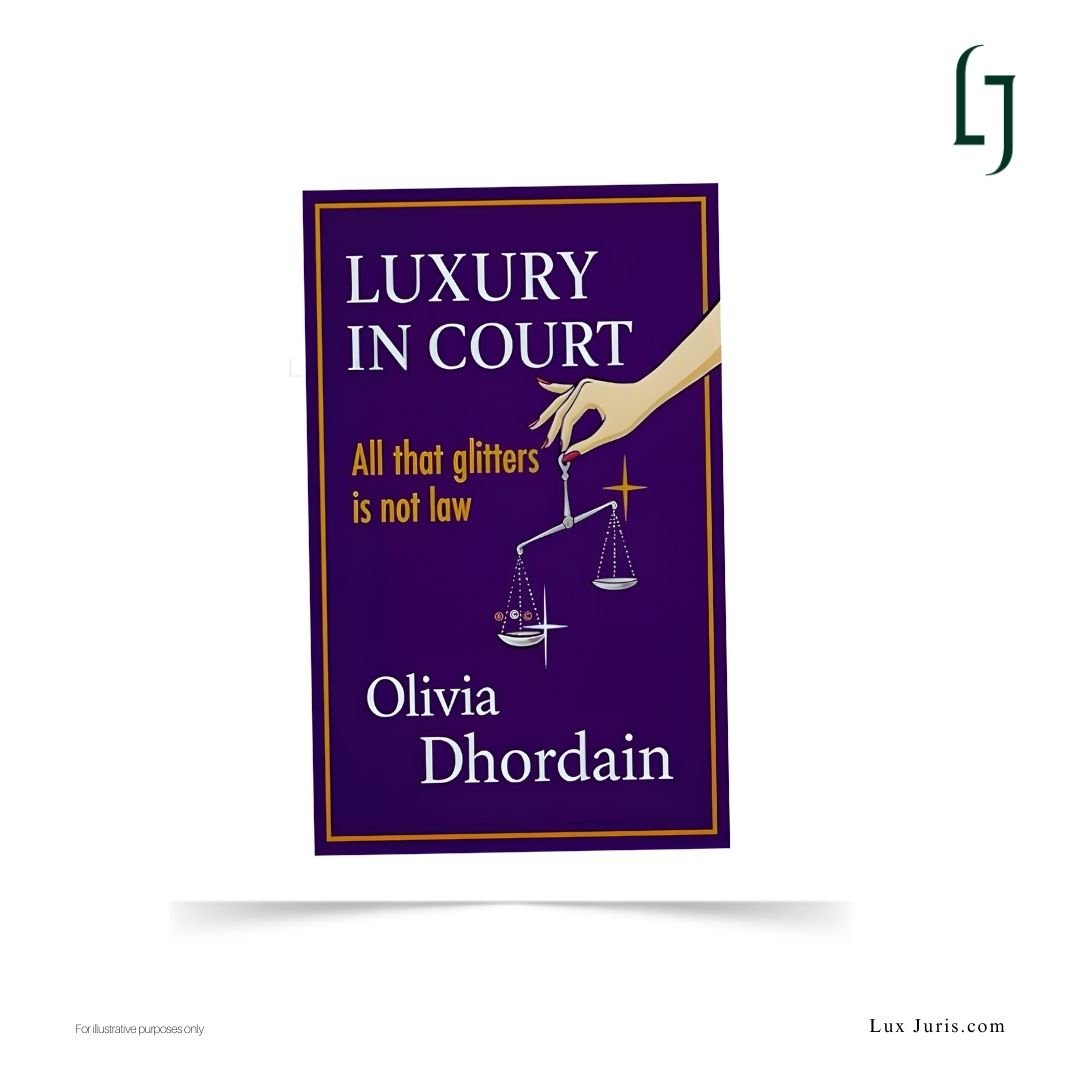
We all know a fundamental truth of this profession: that, like an athlete, it demands intense dedication. To reach the top, one cannot avoid constant preparation, study, and practice, which is why law is often called a jealous mistress. Our work is a discipline that occupies time, attention, and thought, leaving little space for anything outside its own internal logic. Yet if one remains too long within a single territory, it is easy to forget the wider beauty one wishes to embrace. That is why it is necessary, from time to time, to step away: to travel, to play sport, to learn a new recipe and host others, or simply to read something different.
It is in this spirit that Olivia Dhordain’s book drew me in. Luxury in Court: All That Glitters Is Not Law interested me not as a departure from practice, but as a continuation of it in another form. A way of placing into language a professional life that usually circulates through files, negotiations, and decisions, a life we could recognise and relate to. The book seemed to propose a simpler gesture, a step away from professional routines, a way of giving shape to that life in words, in chapters, and in a style that is her own voice, her own logic, her own way of seeing.
We had a call, during which I asked many questions and our conversation covered a wide range of topics. She moved between cases, conflicts, and stories with an ease that reflected her experience, simplifying without ever diminishing the nuance of the disputes she described, which I take as evidence of a command not only of law, but of its practice in full.
On the screen, behind her, a blurred shape remained in view, something I could not quite identify. The longer the conversation went on, the more it felt intentional. Not concealed, but not clarified either, it stayed present as something private, quietly insisting on its presence without entering the discussion.
It remained unresolved, neither explained nor withdrawn. It did not function as background in the usual sense, but as a parallel activity, running quietly alongside the conversation, neither competing with it nor submitting to it.
Only towards the end did I learn that it was her own artwork, something she works on outside her legal practice. A form of making without clients, without disputes, without questions of ownership, an activity that does not require validation in order to exist.
In that sense, her book too began to resemble this blurred background. It asks to be deciphered, but not concluded. Not as a case, not as a problem, and certainly not as a professional performance, but rather as a trace of a life that exceeds its own discipline and cannot be fully contained by it.
So instead of asking her another question about the book, I asked something else, not as a questioner, but as someone proposing a form of shared authorship. I asked her what she would add, if she were to write one more chapter.
“If you had to add one more chapter to your book, what would it be?”
If you’re curious, take a look at: Luxury in Court: All That Glitters Is Not Law