
The dispute arose from the repurposing and resale of second-hand Louis Vuitton Malletier handbags by Shenzhen Bangtu Cultural Media Co., Ltd (Bangtu). The defendant acquired pre-owned Louis Vuitton bags, dismantled them, and reassembled the materials into altered handbags, which were sold through online platforms.
Louis Vuitton initiated proceedings before the Hangzhou Intermediate People’s Court, alleging trademark infringement and unfair competition. It argued that Bangtu’s practices went beyond the lawful resale of second-hand goods and amounted to unauthorised commercial use of its trademarks on materially altered products, thereby undermining Louis Vuitton’s control over the origin, quality, and market attribution of the goods sold under its marks.
Bangtu presented its activities as embodying the principles of circular reuse. In practice, however, the resulting products retained Louis Vuitton trademarks prominently on the exterior, identical or highly similar to those registered in Class 18 for handbags and related goods. By contrast, Bangtu’s own labels were confined to interior placements or zipper hardware and were insufficient to displace the original trademarks’ function as indicators of origin.
The Court upheld Louis Vuitton’s claims, finding that Bangtu’s conduct constituted both trademark infringement and unfair competition, and rejected the defendant’s argument that the products’ recycled nature or interior branding exempted it from liability.
Trademarks as indicators of origin, not decoration
Central to the Court’s reasoning was the function of Louis Vuitton’s trademarks. The Court rejected any attempt to characterise the retained marks as decorative remnants of recycled materials. Instead, it treated them as legally protected indicators of commercial origin and quality.
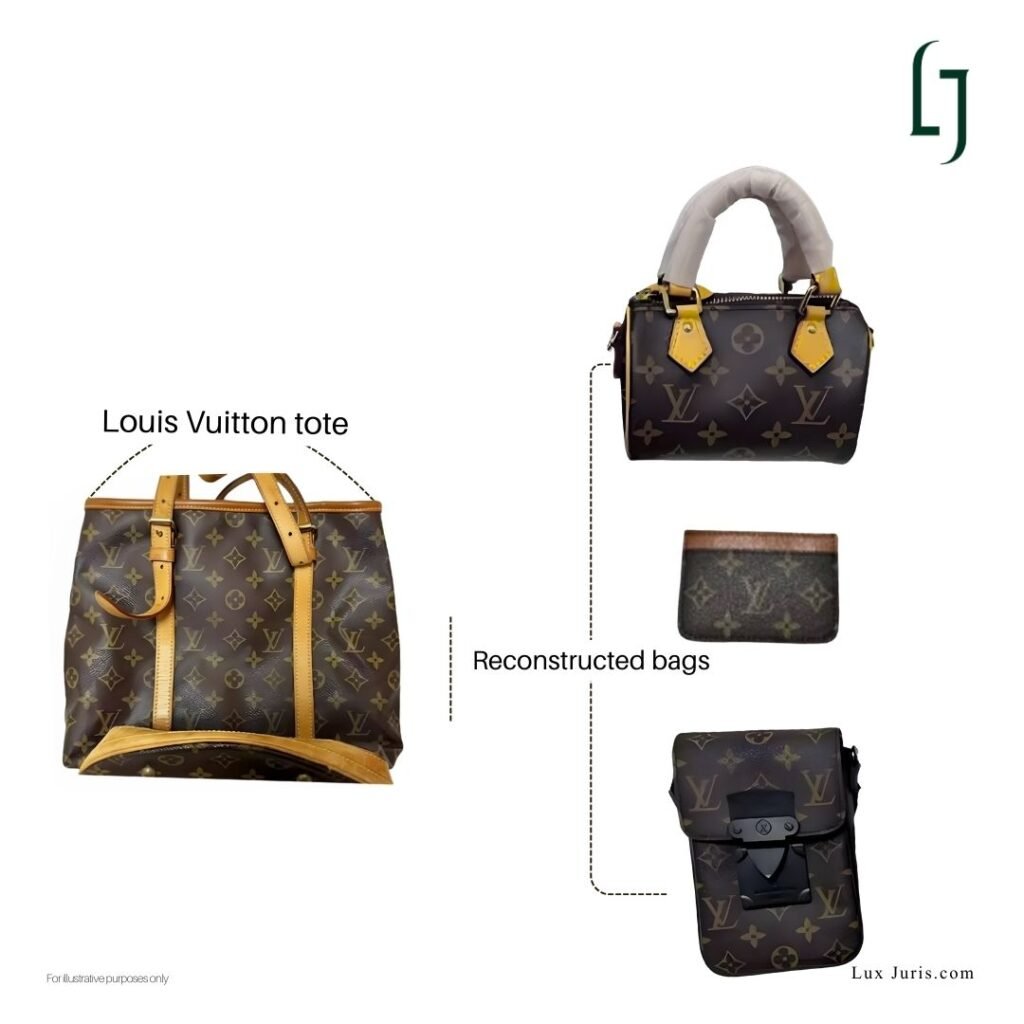
Given the high level of recognition and distinctiveness associated with Louis Vuitton’s trademarks, their continued presence on the altered bags conveyed a clear message to the market. The Court emphasised that trademark protection is not confined to the moment of sale or to the understanding of the immediate purchaser. It extends to how goods are perceived throughout their circulation, including by third parties encountering them in everyday use.
By leaving the Louis Vuitton trademarks prominently visible, Bangtu allowed the altered bags to continue presenting themselves as Louis Vuitton products, notwithstanding the fact that Louis Vuitton had no involvement in their redesign, assembly, or quality control.
Post-sale perception and attribution
Although the judgment did not expressly frame its analysis in terms of post-sale confusion, the Court addressed the issue in substance. Once the bags entered ordinary use, packaging, online descriptions, and sustainability narratives would fall away. Interior labels and zipper markings would not be readily visible. The exterior trademarks, however, remained immediately apparent.
This imbalance ensured that the altered bags continued to be attributed to Louis Vuitton in the eyes of the public. The Court treated this as an interference with the trademark’s attribution function, allowing a third party to benefit from Louis Vuitton’s brand reputation while disconnecting the marks from the conditions under which Louis Vuitton products are designed, manufactured, and controlled.
The infringement therefore lay not only in the act of resale, but in the continued projection of Louis Vuitton’s brand identity after the goods had been materially transformed.
Exhaustion and material alteration
Bangtu relied on the doctrine of trademark exhaustion, arguing that the altered bags were derived from genuine Louis Vuitton products lawfully placed on the market. The Court accepted that exhaustion limits a trademark owner’s control over the resale of genuine goods. However, it rejected the application of exhaustion to goods that no longer correspond to the original products.
The Court emphasised that exhaustion presupposes continuity between the goods placed on the market by the trademark owner and those subsequently resold. Once a product is dismantled and materially altered, that continuity is broken. Even if the materials originated from genuine Louis Vuitton bags, the resulting products differed substantially in form, composition, and overall presentation.
Where such material alteration occurs, the Court held that trademark rights are not exhausted. The continued use of the trademark on altered goods re-engages the trademark owner’s right to control how its marks function in the market.
Quality control and brand integrity
The Court also placed significant emphasis on Louis Vuitton’s loss of quality control. The altered bags were produced outside Louis Vuitton’s manufacturing processes and technical standards. By retaining the trademarks on goods beyond Louis Vuitton’s supervision, Bangtu exposed the brand’s reputation and accumulated goodwill to risks disconnected from Louis Vuitton’s own choices.
This was not treated as a hypothetical concern. The Court reaffirmed that quality control is a core function of trademark law. Permitting third parties to retain trademarks on materially altered goods would undermine the trademark owner’s ability to ensure consistency and reliability, and would weaken the legal structure that trademarks are intended to protect.
Circular reuse and the limits of trademark law
The Court acknowledged that the reuse of second-hand goods may align with environmental and resource-efficiency objectives. However, it drew a clear boundary between sustainability narratives and trademark rights. Environmental considerations do not authorise the continued commercial use of a trademark outside the control of its owner.
Where second-hand fashion and luxury goods are dismantled and repurposed, lawful reuse requires a clear separation from the original trademark association. This entails removing or obscuring the original trademarks and ensuring that any reworked products are clearly and prominently branded under the reworking party’s own marks.
Absent such separation, repurposing moves beyond permissible reuse and constitutes unauthorised trademark use. The Court’s decision clarifies the point at which exhaustion no longer applies to materially reworked fashion and luxury goods.
Sources:
Deconstructing the Boundaries of Trademark Exhaustion in the Era of Up-cycled Luxury