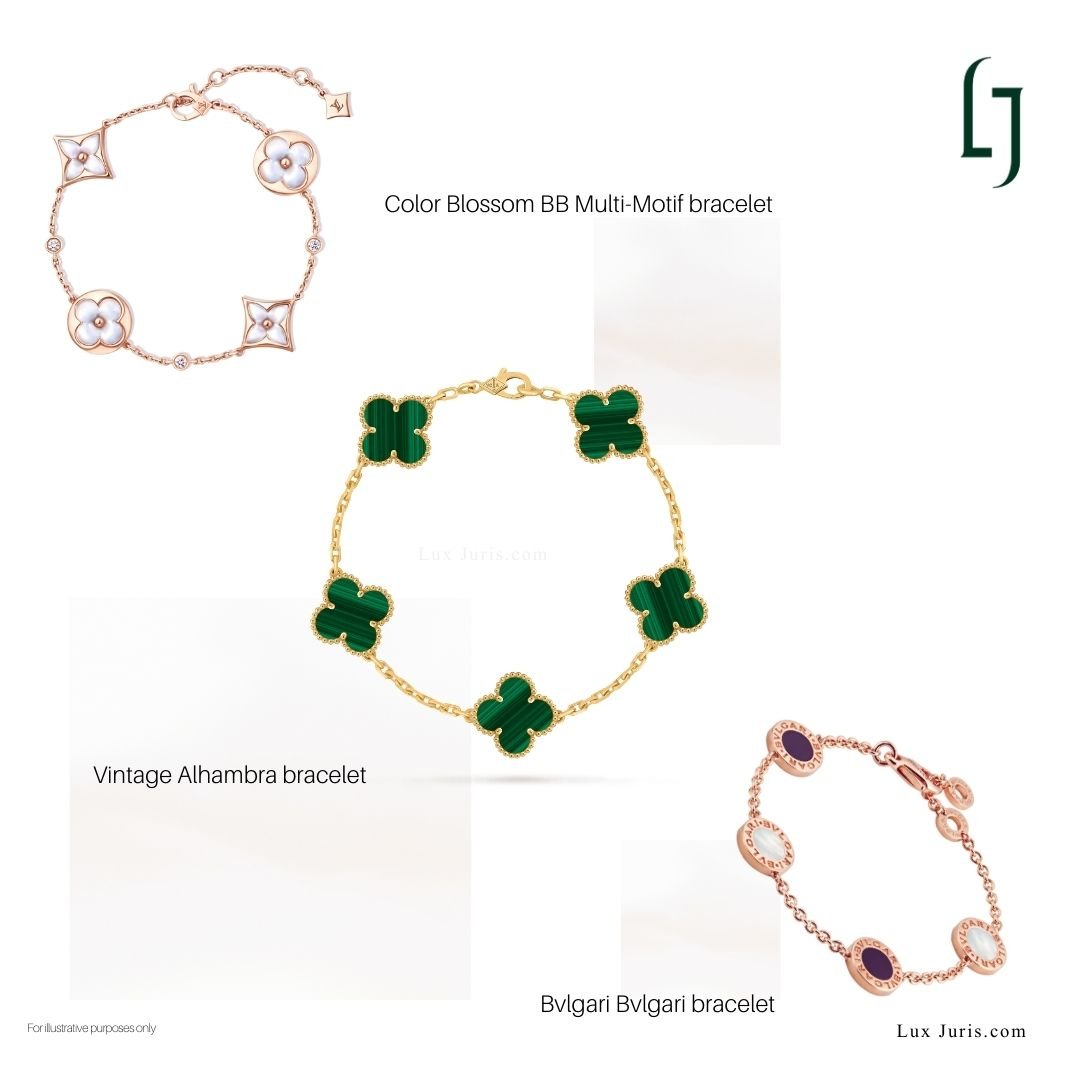
Jewellery design operates in a narrow creative corridor. Most collections are built from a shared repertoire of forms, the serpent, the nail, the clover, floral clusters, articulated chains, minimalist bands, textured hoops or geometric links, and differentiation often lies not in the motif itself, but in proportion, modelling, material treatment and composition. A few millimetres in curvature, the balance of volumes, the articulation of a clasp, or the way stones are set can determine whether a piece reads as a new design language or as a recognisable echo of an existing brand universe.
French courts accept this reality. They do not expect designers to invent new motifs. They expect brands to develop their own expressive identity within the common visual grammar of the sector. What the law protects is not the trend, but the brand-specific expression of that trend.
For jewellery houses, fashion brands expanding into jewellery, and independent designers entering the French market, this is not a theoretical line. A finding of infringement or parasitism can lead to injunctions, forced withdrawal of stock, renaming of collections, delisting from platforms, and damages ranging from symbolic sums to six-figure awards. The real legal boundary of permissible inspiration in France is therefore not intention, but market perception, brand positioning, and economic effect. The question is not whether you meant to copy, but whether your product is commercially legible as your own.
Originality in French jewellery law is not novelty, but creative identity
Under French copyright law, jewellery is protected as an artistic work when it reflects identifiable creative choices that go beyond generic form. Courts do not require technical innovation, patentable invention or industrial novelty. They look for a recognisable creative signature, visible in the way elements are selected, combined and proportioned.
This was confirmed by the Paris Court of Appeal in Bulgari vs APM Monaco. Bulgari’s Serpenti jewellery was held to be original not because Bulgari invented the serpent motif, but because of the specific sculptural treatment of the head, the modelling of the scales, the balance of proportions, and the use of pear-cut gemstone eyes. These choices produced a design language that the court recognised as visually identifiable and commercially coherent.
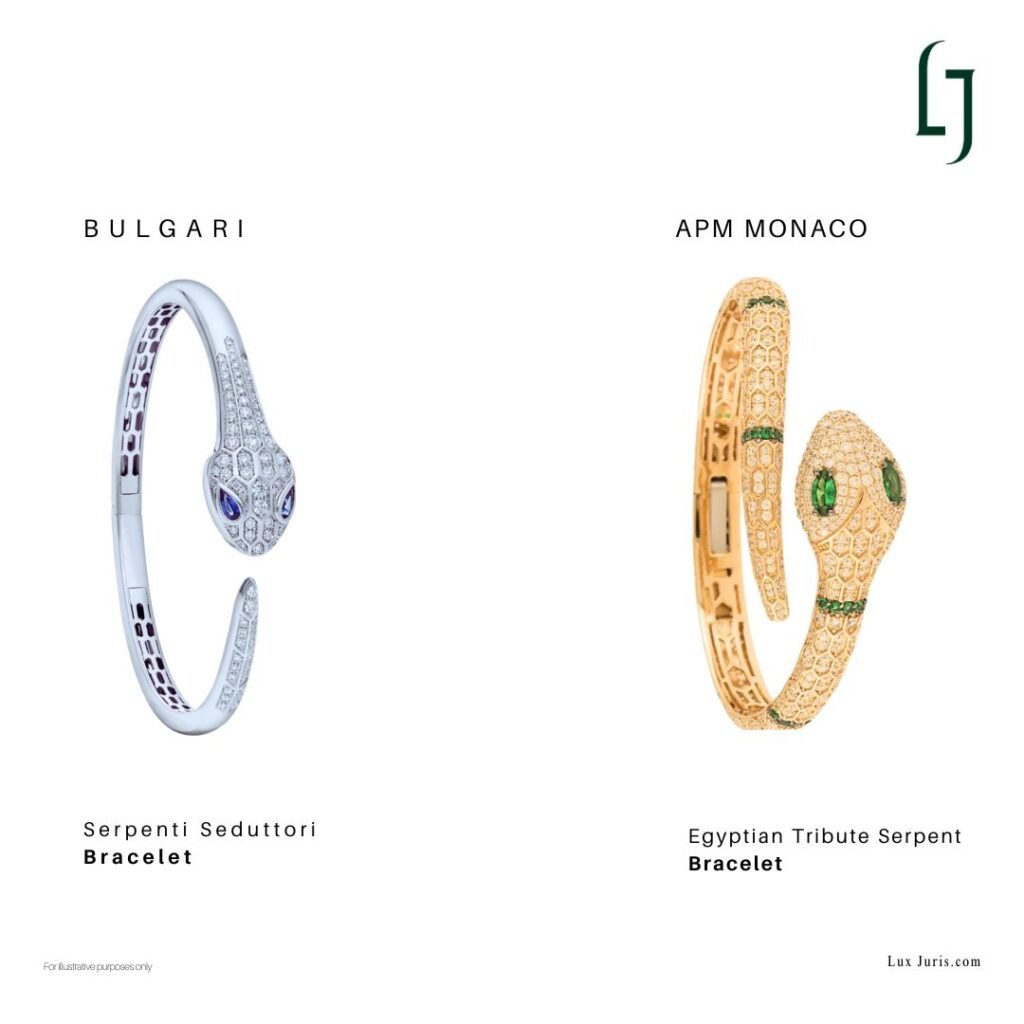
At the same time, the court rejected Bulgari’s copyright infringement claim. Although APM also used serpent imagery, its pieces generated a different overall visual impression. The forms, proportions and aesthetic logic were sufficiently distinct for the court to conclude that APM had not reproduced Bulgari’s protected expression.
For brand owners, this distinction is critical. French law allows designers to work with shared visual codes. What it does not allow is the replication of another brand’s aesthetic identity. Originality is not about how many elements are borrowed, but about whether the final design reads, to the market, as belonging to a different creative universe.
Trademark distinctiveness arises from commercial use, not visual complexity
In jewellery, branding often sits directly on the product. Engravings, recurring words, symbols and collection names operate simultaneously as design features and as brand indicators. French trademark law treats these elements as legally significant when they function as indicators of commercial origin, not merely as decoration.
This logic was central in Cartier vs Goussin. The case did not turn on whether the word LOVE was inherently distinctive. It turned on how Goussin used it. LOVE appeared as a product name, as a bracelet engraving, and as a core element of the commercial narrative. In that context, the court held that the word was not decorative language but trademark use, and that it infringed Cartier’s established rights.
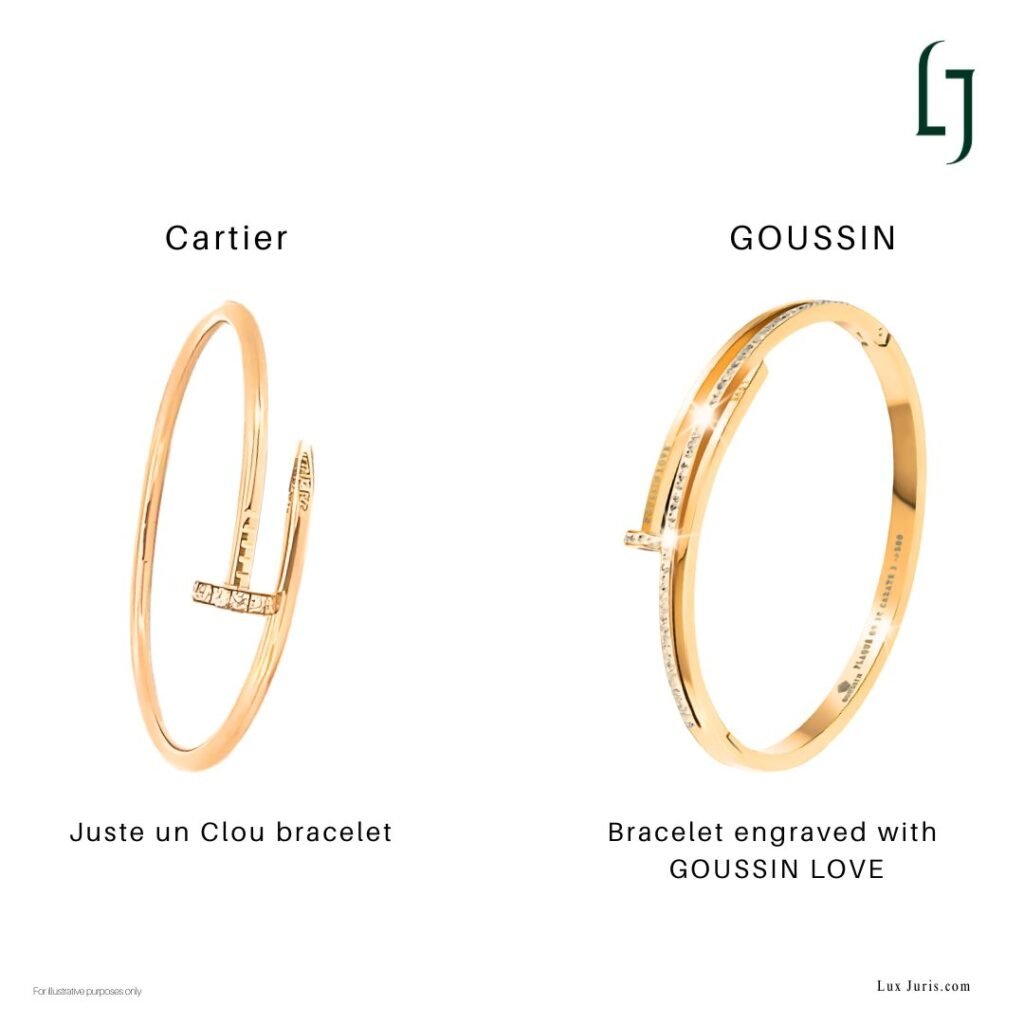
For brands, trademark risk depends on how a sign is used within the brand architecture. Product names, engravings, collection names, category labels and marketplace listings are not just marketing choices. In France, they are treated as legally relevant acts of sign use and can establish trademark use, infringement, or liability.
Parasitism targets brand value capture, not design similarity
French parasitism law is where most jewellery disputes are actually won or lost. It applies even when copyright and trademark claims fail. It is not concerned with formal similarity. It is concerned with economic positioning.
A brand commits parasitism when it places itself in the commercial wake of another, benefiting from the symbolic capital, reputation and market investment of that brand without building comparable creative or commercial foundations.
This is exactly what happened in Bulgari vs APM Monaco. Although APM avoided copyright infringement, the court held that its serpent-themed collections were designed and positioned to benefit from the luxury identity constructed by Bulgari’s Serpenti line. APM had not built an equivalent design mythology, historical narrative or brand investment around the serpent. It had inserted itself into Bulgari’s brand space.
The court imposed an injunction and awarded approximately €130,000 in damages.
What matters here is not confusion. The court did not need to show that consumers believed APM was Bulgari. It was enough that APM economically benefited from Bulgari’s brand storytelling and symbolic construction of the serpent as a luxury sign.
French courts analyse jewellery as a full brand system
When jewellery disputes reach French courts, judges do not isolate the object on a neutral background. They examine the entire brand ecosystem: product naming, collection architecture, campaign imagery, catalogue structure, online listings, SEO strategy, hashtags, craftsmanship claims, quality narratives and implied brand associations.
A design may survive a side-by-side comparison and still fail a parasitism analysis. A product may avoid trademark infringement and still constitute unfair competition. What is evaluated is not the isolated jewel, but the brand strategy embodied in the jewel.
This is why interpretation is not a legal defence in France. Inspiration is not judged subjectively. It is judged commercially. The operative question is whether the brand has created its own design language and brand equity, or whether it is extracting value from someone else’s.
Market entry checklist for jewellery brands entering France
- You may use shared industry motifs, but not a competitor’s brand-specific expression.
- You may not use a competitor’s signature element as a product name, engraving or collection identifier.
- Your collection must read as an independent design language within the French market.
- You must build and document your own creative direction and brand narrative.
- You must vet product titles, listings, imagery, tags and category positioning.
- You must assume parasitism risk applies to brand owners, designers, retailers and platforms alike.
Conclusion
French law does not prohibit resemblance. It regulates brand value appropriation. Inspiration remains lawful until the market begins to read a product not as part of a trend, but as part of someone else’s brand universe. And because French courts analyse jewellery through the full brand system, not just the physical object, the commercial rule for entering France is unforgiving but clear. If your product draws on another brand’s identity, history or symbolic capital to make itself legible in the market, a French court will see parasitism, even where customers see no confusion.