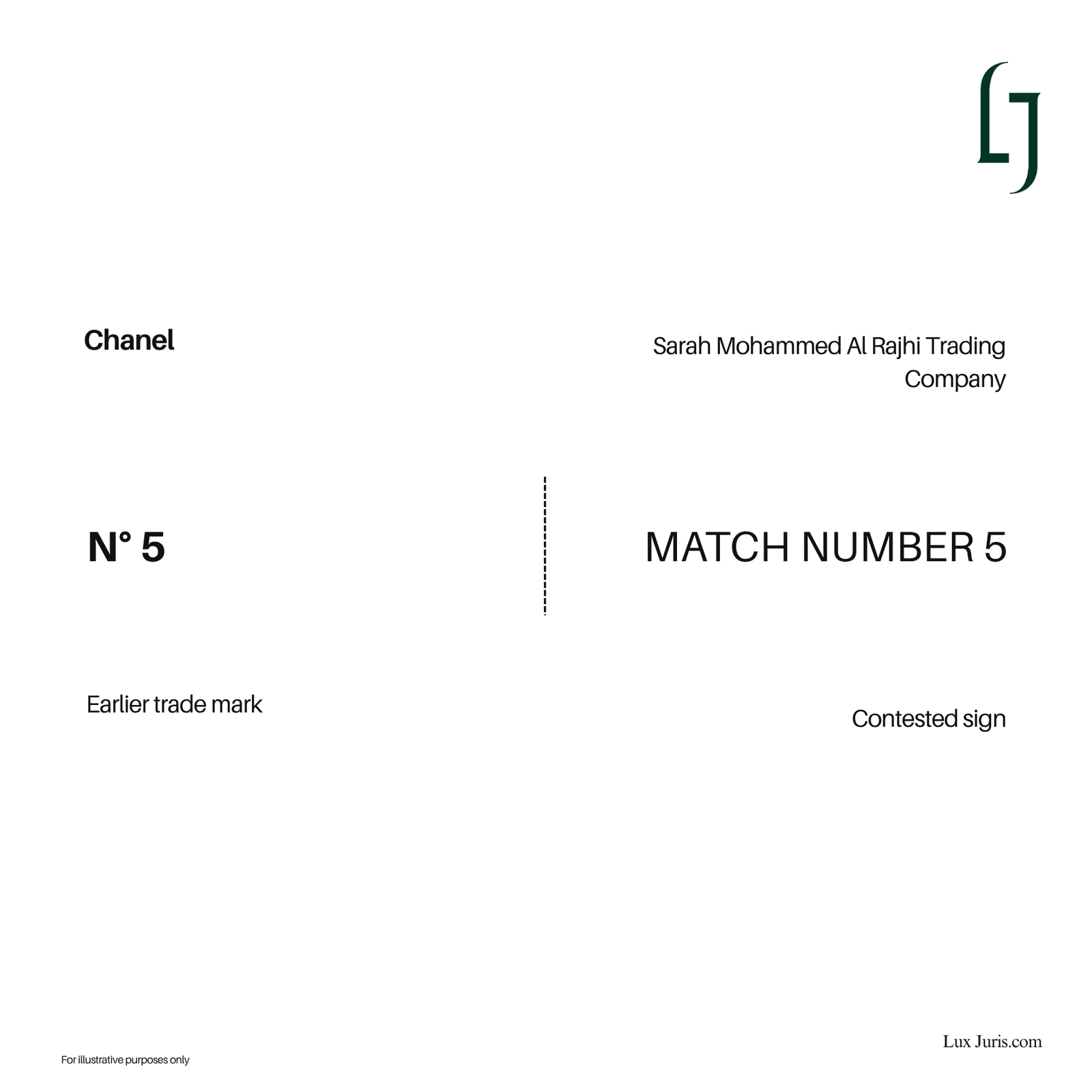
The EUIPO rejected MATCH NUMBER 5 for perfumes, cosmetics and related Class 3 goods after finding that consumers in France would connect it with CHANEL’s N°5. The decision is particularly interesting because the signs were only weakly similar visually and aurally, yet the opposition succeeded on reputation and unfair advantage.
Some trade mark disputes turn on how closely two signs look or sound. This one turned more on what the later mark was understood to be saying, and on whether that meaning allowed the applicant to draw commercial benefit from the reputation of an earlier mark.
Sarah Mohammed Al Rajhi Trading Company sought to register MATCH NUMBER 5 as an EU trade mark for a wide range of Class 3 goods, including perfumes, cosmetics, toiletries and essential oils. Chanel opposed the application on the basis of its earlier French word mark N° 5, relying on both likelihood of confusion under Article 8(1)(b) EUTMR and the protection given to reputed marks under Article 8(5).
The EUIPO Opposition Division upheld Chanel’s opposition in full. It did not need to decide whether consumers would confuse the two marks, because it found that MATCH NUMBER 5 would bring N°5 to mind and allow the applicant to benefit from the reputation attached to Chanel’s perfume.
The opposition
Chanel relied on French trade mark registration No 1 293 767 for N° 5, while the contested mark was MATCH NUMBER 5, filed on 17 June 2025 for an extensive list of goods in Class 3. Chanel opposed the application in its entirety and relied on both Article 8(1)(b) and Article 8(5) EUTMR.
Article 8(5) allows an earlier reputed mark to prevent registration of a later identical or similar sign even where the respective goods or services are not identical or similar. The opponent must establish, among other things, that the earlier mark has the necessary reputation, that the signs are sufficiently similar for consumers to make a mental link between them, and that use of the later sign is likely to take unfair advantage of, or cause detriment to, the earlier mark.
The applicant did not claim that it had due cause to use MATCH NUMBER 5. The dispute therefore centred on whether Chanel could establish reputation, similarity, a link between the signs and a resulting risk of injury.
How Chanel proved the reputation of N°5
Much of the decision is devoted to Chanel’s evidence, which extended across decades and included press coverage, advertising campaigns, YouTube videos, Instagram material, exhibitions, rankings and commemorative material connected with the perfume.
The evidence also documented the unusually long cultural life of N°5. Materials before the EUIPO referred to advertising involving Nicole Kidman, Brad Pitt and Marion Cotillard, among others, while French press reports repeatedly described the fragrance as a long-standing bestseller and an enduring perfume icon.
Chanel also relied on exhibitions at the Palais de Tokyo and the Grand Palais Éphémère, along with a commemorative stamp collection produced with La Poste for the perfume’s 100th anniversary. The Opposition Division considered this body of material sufficient to demonstrate a long and uninterrupted presence of N°5 in the French market and in French public consciousness.
Chanel had not produced precise market-share figures or independent market research, and the evidence did not specify advertising expenditure. Even so, the EUIPO considered the overall record sufficient because the volume, duration and prominence of national press coverage, advertising and public-facing activity supported the conclusion that N°5 had acquired reputation in France.
The decision ultimately described N°5 as having at least an average degree of reputation in France for perfumes. Later in the decision, however, the Opposition Division referred to the mark as having been found reputed “to a high degree”, creating a small internal inconsistency in the wording, although not one that changed the outcome.
Reputation for perfume did not automatically extend to cosmetics
Chanel had claimed reputation for both perfumery products and cosmetics, but the EUIPO did not accept the claim in full. Most of the evidence concerned perfume, and although Chanel had submitted material showing products such as make-up, creams, shower gel, deodorant and soap carrying N°5, the Opposition Division considered the cosmetics evidence too limited.
There was also evidence concerning a cosmetics range released around the fragrance’s centenary, but much of that material came from Chanel itself and was not supported by independent sources of sufficient weight. The result was therefore narrower than Chanel had sought, with reputation established for perfumes but not separately for cosmetics or the other perfumery goods relied upon.
This becomes important later in the decision because the contested application extended well beyond perfume. Chanel nevertheless succeeded against the entire Class 3 specification, not because N°5 had been shown to have reputation for every product listed, but because Article 8(5) can protect a reputed mark across a wider range of goods where the necessary link and unfair advantage are established.
N°5 and MATCH NUMBER 5 were not especially close visually
The comparison between the signs is one of the more interesting parts of the decision because the Opposition Division did not find a high degree of similarity.
For French consumers, N° 5 would be understood as numéro cinq, or number five. The EUIPO also considered that French consumers would understand the word NUMBER because of its proximity to the French word numéro, meaning that NUMBER 5 would communicate the same underlying concept as N°5.
The word MATCH introduced an additional idea. The Opposition Division considered that at least part of the French public would understand it through the French Anglicism matcher, meaning broadly to correspond, coincide, fit or go well together.
Even with that conceptual overlap, the signs were visually quite different. N°5 is extremely short, while MATCH NUMBER 5 contains three elements, begins with MATCH and uses the full word NUMBER rather than the abbreviation N°.
The EUIPO therefore found only a low degree of visual similarity and a below-average degree of aural similarity. Conceptually, however, the signs were considered similar to an average degree because both conveyed the idea of number five, despite the additional meaning introduced by MATCH.
The opposition therefore did not depend on treating MATCH NUMBER 5 as a conventional close imitation of N°5. The case instead moved towards whether the meaning of the later sign would cause consumers to make a connection with the earlier reputed mark.
Whether consumers would make a connection
Article 8(5) requires more than similarity between two signs. The relevant public must establish a mental link between the earlier reputed mark and the later sign, and the existence of that link is assessed by looking at the marks, the goods, the reputation and distinctiveness of the earlier mark, and the relationship between the respective markets.
The goods for which N°5 had been found reputed were perfumes. The contested application, however, covered perfumes, cosmetics, toiletries and essential oils, and the EUIPO found that the great majority of those goods were at least similar to perfume to some degree.
Even where particular goods might technically be dissimilar, the Opposition Division considered them closely related to the beauty sector and directed mainly at the general public. That commercial proximity, combined with the reputation of N°5 and the conceptual connection between the signs, was enough for the EUIPO to find that French consumers encountering MATCH NUMBER 5 were likely to associate it with Chanel’s earlier mark.
That association, however, was not enough by itself. Chanel still had to establish one of the forms of injury protected by Article 8(5), and its case focused on unfair advantage.
Why MATCH changed the case
Unfair advantage concerns the benefit obtained by the later mark rather than direct damage caused to the earlier proprietor. It covers situations in which the attractiveness, image or reputation of an earlier reputed mark can make the later goods easier to market.
The role of the word MATCH became particularly important at this stage. The Opposition Division considered that MATCH NUMBER 5 would not merely cause consumers to think incidentally of N°5, but would instead be understood as a direct reference to the earlier perfume.
The later sign suggested that the goods sold under MATCH NUMBER 5 match or are equivalent in quality, fragrance and prestige to those marketed under N°5. This reading allowed the EUIPO to move from association to unfair advantage, because the applicant could benefit from the commercial attraction and prestige attached to N°5 without having made the investment required to create that reputation.
The additional word therefore performed two different functions in the analysis. Visually and aurally, MATCH helped distinguish the later sign from N°5, but conceptually it helped explain how consumers were supposed to understand NUMBER 5.
That is one of the most interesting aspects of the decision. The extra wording created distance at the level of appearance while strengthening the commercial reference at the level of meaning.
The decision did not depend on confusion
The marks were not found highly similar, and the Opposition Division did not need to conclude that consumers would believe MATCH NUMBER 5 came from Chanel. Visual similarity was low, aural similarity was below average and conceptual similarity reached only an average degree.
Article 8(5), however, addresses something different from ordinary source confusion. The relevant question was whether the later mark would bring N°5 to mind and whether that association could allow the applicant to benefit from the reputation of the earlier mark.
The reasoning therefore followed a different path. N°5 had reputation in perfume, NUMBER 5 reproduced the same core concept, MATCH suggested correspondence or equivalence, the contested goods were closely connected with the beauty sector, and consumers were therefore likely to establish a link between the signs. Once that link was established, the Opposition Division found that the prestige of N°5 could transfer some commercial advantage to MATCH NUMBER 5.
Because Chanel succeeded on Article 8(5), there was no need for the Opposition Division to examine the separate likelihood-of-confusion claim under Article 8(1)(b). The decision therefore offers a useful example of the distance between ordinary similarity analysis and the wider protection available to marks with reputation.
A comparison claim can create the problem
MATCH NUMBER 5 is particularly interesting because the additional word did not simply make the later mark more distinctive. In one sense, MATCH increased the distance between the signs because it was the first word in the application, had no counterpart in N°5 and contributed to the findings of low visual and below-average aural similarity.
Semantically, however, it worked in the opposite direction. Once MATCH was understood as saying that one thing corresponds to another, NUMBER 5 supplied the object of that comparison, so the later mark could be read as telling consumers that the product matched N°5.
The structure of the expression therefore mattered. This was not simply a situation in which part of a famous mark happened to appear inside a longer expression, because the additional wording itself helped explain why the famous mark was being referenced.
That point is particularly relevant in the perfume market, where equivalence language is commercially familiar. Traders may wish to describe a fragrance as resembling, matching or offering an alternative to an established scent, but the legal analysis does not end with whether consumers can distinguish between the two traders.
Where the reference is sufficiently connected to a reputed mark, the question may instead become whether the later trader is using the attraction and reputation of that mark as part of the commercial presentation of its own product.
Why Chanel could stop goods beyond perfume
Another important part of the decision is the reach of the refusal. Chanel established reputation only for perfumes, yet MATCH NUMBER 5 was rejected for the entire list of contested goods, including cosmetics, toiletries and essential oils.
That follows from the structure of Article 8(5), which is not confined to identical or similar goods in the same way as an ordinary likelihood-of-confusion claim. A reputed mark can receive protection against later use on dissimilar goods where consumers will nevertheless establish the necessary link and where unfair advantage or detriment is likely.
Here, the Opposition Division considered the contested goods sufficiently connected with the beauty sector. Their relationship with perfume, combined with the reputation of N°5 and the meaning conveyed by MATCH NUMBER 5, supported the link across the entire specification.
The decision therefore does not mean that Chanel established N°5 as a reputed mark for every cosmetic product. It means that reputation in perfume was capable, on these facts, of preventing registration across a wider group of beauty goods.
What the decision means for perfume comparisons
The decision sits close to a recurring issue in the fragrance market: how a trader can communicate that a perfume resembles, corresponds to or offers an alternative to a known fragrance without turning the earlier mark’s reputation into part of its own branding.
MATCH NUMBER 5 went further than using a descriptive comparison somewhere in advertising because the wording itself was the trade mark application. The comparison was therefore built into the sign by which the applicant proposed to identify its goods.
The EUIPO’s reasoning does not establish that every reference to a famous perfume number will be prohibited, nor does it mean that all comparative language involving fragrance equivalents will infringe trade mark rights. The assessment remains dependent on the sign, the goods, the reputation of the earlier mark and the way the later wording will be understood by consumers.
What the decision does show is that adding words around a reputed sign will not necessarily create legal distance where those words make the reference more explicit. A later mark can look less like the earlier mark while still making the commercial association stronger.
The outcome
The Opposition Division upheld Chanel’s opposition for all contested goods, rejected EU trade mark application No 19 203 575 in its entirety and ordered the applicant to bear costs fixed at €620. Because Article 8(5) was sufficient to dispose of the application, the Opposition Division did not examine Chanel’s separate likelihood-of-confusion ground under Article 8(1)(b).
The decision was issued on 6 October 2026 and remained subject to the appeal procedure set out in the EUTMR. The more interesting point for perfume brands is not that Chanel successfully stopped an almost identical version of N°5, because MATCH NUMBER 5 was structurally different and the EUIPO expressly found only limited visual and aural similarity.
What caused the difficulty was the combination of a reputed perfume mark, the retained concept of NUMBER 5, and a word, MATCH, that told consumers how the applicant wanted that number to be understood. In this case, the additional word did not take the later mark further away from N°5. It helped explain the connection.
Source: