A rights holder may have registered trademarks, substantial goodwill and a credible basis for enforcement. Another sign may be similar, used commercially in a related space or capable of suggesting a connection that does not exist. The legal position may therefore be strong, yet the dispute itself can still damage the brand that enforcement was intended to protect.
The reason is that courts and the public are often considering different questions. Courts examine matters such as the similarity between the marks, how they are being used, the goods or services involved and whether consumers are likely to assume a commercial connection. Depending on the jurisdiction and the strength of the mark, the inquiry may also extend to dilution, unfair advantage or harm to distinctiveness.
Public opinion works differently. It is less concerned with the technical boundaries of trademark protection and more responsive to the story surrounding the dispute. Who appears powerful, who appears vulnerable, whether the action seems proportionate and whether the company is behaving consistently with the values it promotes can become as important to the public narrative as the underlying infringement claim.
Legal merit remains important, but it does not necessarily determine that narrative. Three recent disputes show how a credible trademark case and the public understanding of that case can move in very different directions.
Patagonia and Pattie Gonia
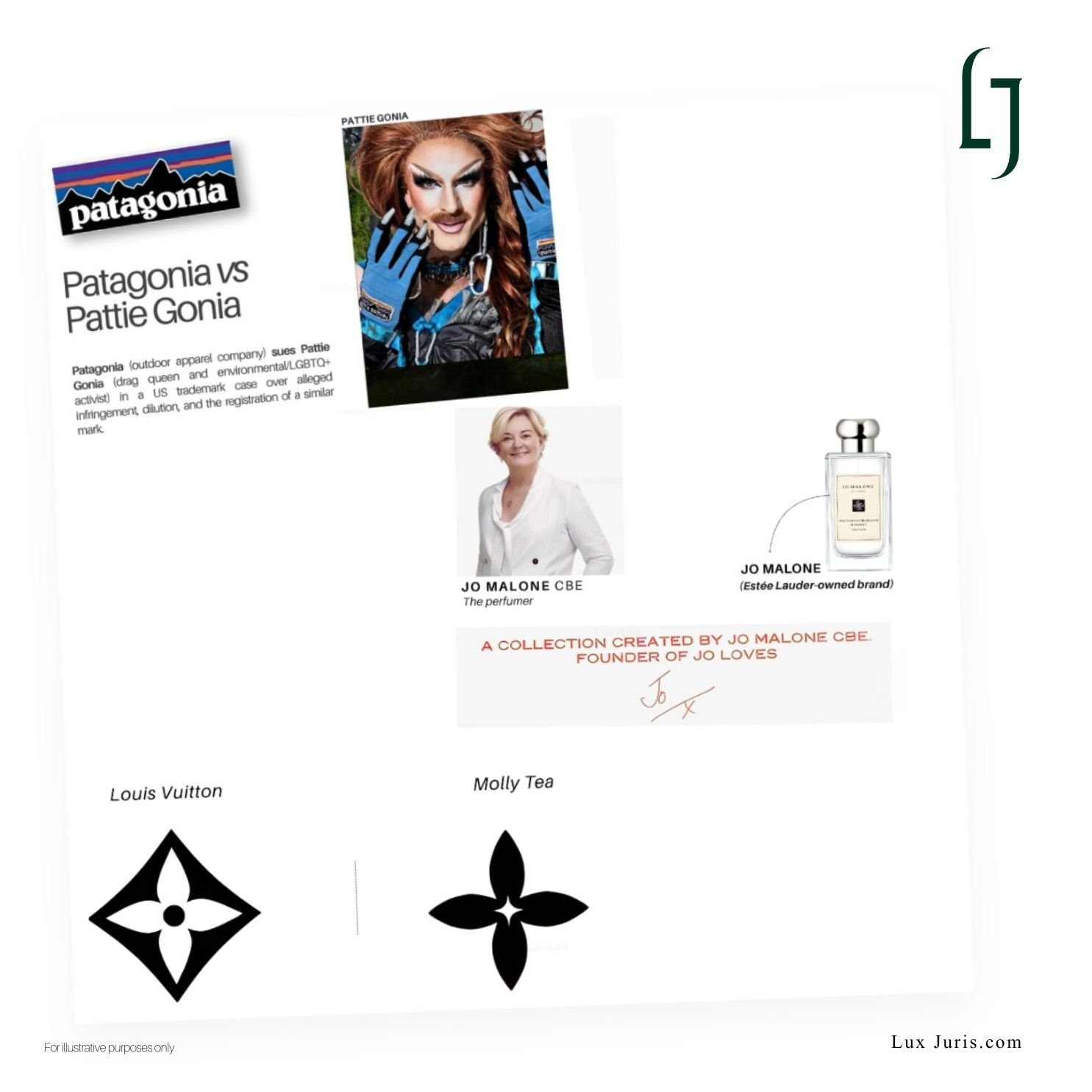
In January 2026, Patagonia filed a federal trademark lawsuit in California against Wyn Wiley, the drag performer and environmental activist known as Pattie Gonia. Patagonia alleges that the PATTIE GONIA name and related commercial use create a likelihood of confusion with its trademarks, and says that the overlap extends beyond the similarity between the names to clothing, outdoor activities and environmental advocacy, areas closely associated with Patagonia’s business and public identity.
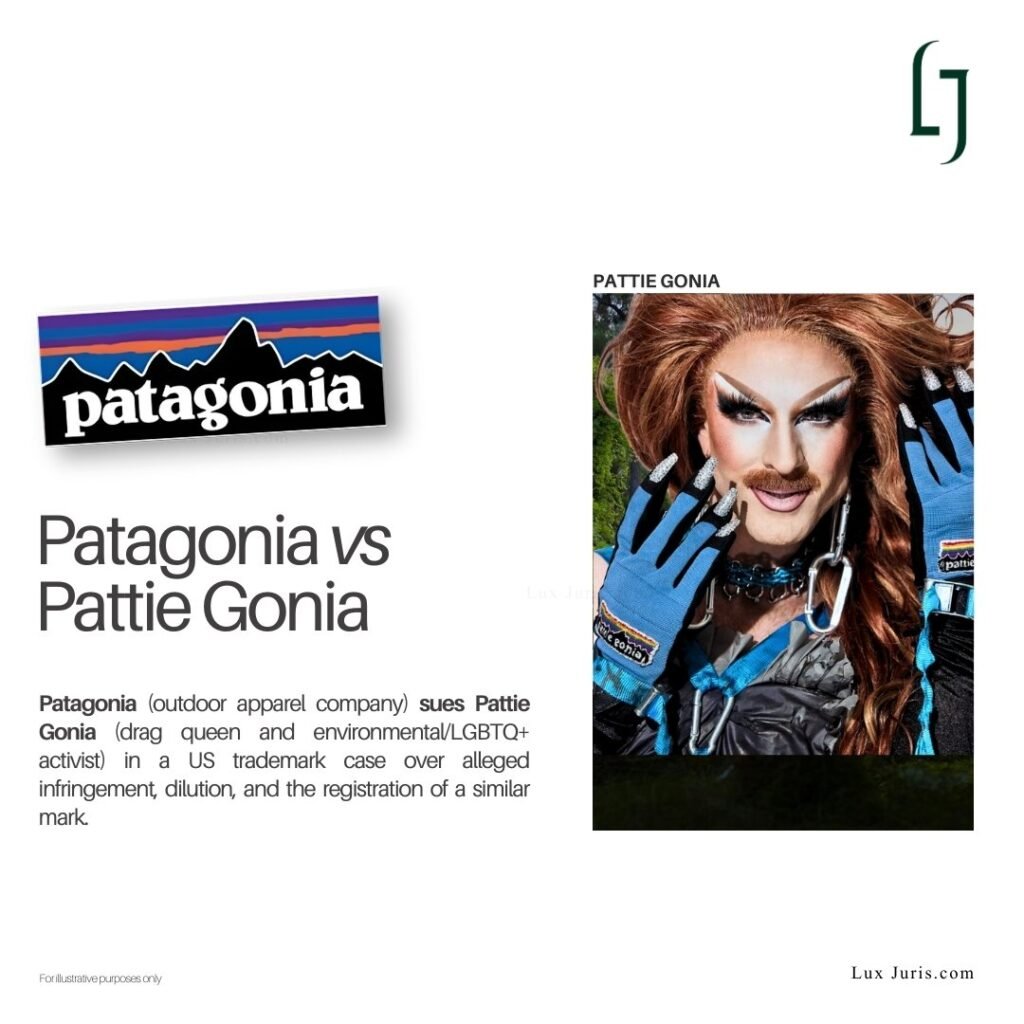
There is also a history between the parties. Patagonia says that it tried to resolve the matter over several years and that Wiley had previously agreed to restrictions concerning commercial use of the name. The company is seeking an injunction and only US$1 in damages. Wiley disputes Patagonia’s account, has denied using Patagonia’s logo or typeface on merchandise and has described some of the material relied upon by Patagonia as parody or fan art.
The legal dispute is therefore more complicated than a large company objecting to a performer’s playful name. The court may have to consider whether Pattie Gonia has developed from a parody-style name into a commercial identity operating sufficiently close to Patagonia’s protected interests, as well as the significance of the parties’ previous dealings.
Outside the courtroom, however, much of that complexity can disappear. Patagonia has spent decades building an identity around environmental responsibility and support for activism, while Pattie Gonia is an environmental activist whose work appears closely aligned with many of those commitments. The dispute can therefore be reduced to a much simpler story: a sustainability company suing a climate activist.
That description does not capture the full legal case. It leaves out the commercial use, the history between the parties and Patagonia’s argument that it is protecting trademark rights built over decades. Yet it gives the public a much simpler story, and one in which Patagonia’s own values become relevant to how its decision to enforce is judged.
This is what makes the dispute particularly difficult for Patagonia. The strength of its reputation supports the value of its trademarks, but that same reputation also creates expectations about how the company will use those rights. The public question is therefore not only whether Patagonia has the right to act, but whether taking action against Pattie Gonia is consistent with the values Patagonia has built its brand around.
Estée Lauder and Jo Malone
The dispute between Estée Lauder and Jo Malone presents the problem differently. Malone founded her namesake fragrance business and sold it to Estée Lauder in 1999. Estée Lauder now owns the Jo Malone London business and the trademarks associated with it, while the current litigation concerns Zara fragrances created in collaboration with Malone and the way her name has been used in connection with those products.
Estée Lauder alleges trademark infringement, passing off and breach of contract. Among the disputed wording are references identifying the fragrances as having been created by Jo Malone CBE. Estée Lauder argues that these uses go beyond the restrictions agreed when it acquired the original Jo Malone business and may lead consumers to assume a commercial connection with Jo Malone London.

The defendants dispute that position. Zara’s UK business argues that the wording identifies Jo Malone as the individual who created the fragrances rather than presenting Jo Malone London as their commercial source. It also says that the presentation followed principles previously communicated by Estée Lauder’s lawyers concerning ways in which Malone could be identified while distinguishing her as an individual from the Jo Malone London brand.
The legal dispute therefore goes beyond ordinary trademark similarity. It may require the court to consider the contractual limits Malone accepted when she sold the business, the trademark rights Estée Lauder acquired through that transaction and the extent to which Malone may continue to identify herself when creating products for another company.
The public story is much easier to tell. A multinational company appears to be trying to prevent the founder of a business from using her own name.
That account leaves out important parts of the transaction. Malone sold the business bearing her name, Estée Lauder acquired valuable trademark rights through that sale, and contractual restrictions are alleged to have formed part of the bargain. Yet the simpler account remains powerful because consumers do not necessarily experience a personal name in the same way as an invented trademark. To them, Jo Malone is not merely a commercial sign owned by a company. It is also the identity of the person who founded the business and helped create the reputation that made the name commercially valuable.
Estée Lauder may ultimately establish that the disputed use infringes its trademarks, breaches contractual restrictions or both. Even then, the company has to explain a position that can appear much broader and more personal outside the courtroom than it does within the legal framework of the dispute.
That is what makes namesake brands particularly difficult. The sale of the business can transfer extensive commercial rights in the founder’s name, but the person whose name created those rights continues to exist independently of the trademark. The legal question is where the rights acquired with the business end and the founder’s ability to identify herself begins. The public is unlikely to approach that boundary with the same precision.
Louis Vuitton and Molly Tea
Louis Vuitton’s dispute with Molly Tea in China presents a third version of the same problem, and shows that the reputational question can continue even after a rights holder succeeds in court at first instance.
Molly Tea is a Chinese tea chain founded in 2021 that has used a four-petal flower device across its shops, cups, packaging and online presence. Louis Vuitton argued that the device was too close to registered flower trademarks forming part of its well-known Monogram identity. On 29 June 2026, the Suzhou Intermediate People’s Court issued a first-instance judgment finding that Molly Tea and another defendant had infringed seven Louis Vuitton trademarks. The court ordered an end to the infringing use and awarded RMB 10 million for economic loss together with RMB 300,000 in reasonable rights-protection expenses, bringing the total to RMB 10.3 million (approximately US$1.5 million). Molly Tea indicated that it intended to appeal.

The legal position is particularly interesting because tea products and luxury fashion goods fall into different commercial categories. The issue was therefore not simply whether consumers might confuse a cup of tea with a Louis Vuitton product. It concerned the protection available to Louis Vuitton’s registered flower devices, including the broader protection Chinese trademark law can provide to well-known marks.
There was also a registration history behind the dispute. Molly Tea had sought registration of related flower devices, and at least one relevant application was refused after earlier marks, including Louis Vuitton flower devices, were cited against it. That history forms part of the wider background, although trademark registration proceedings and infringement proceedings involve separate legal questions.
The first-instance judgment did not settle how the dispute would be understood outside the legal system. Chinese media and online commentators questioned whether an international luxury company should be able to assert exclusive rights against a four-petal design resembling motifs found in historic Chinese decorative art. What began as a dispute over particular registered commercial signs consequently developed into a broader discussion about cultural heritage, foreign ownership and the limits of trademark protection.
That distinction is important. Trademark law does not give Louis Vuitton ownership of every four-petal flower. The legal question concerns particular registered marks, Molly Tea’s particular commercial device and the protection those marks receive under Chinese law. Public discussion asks a much broader question: why should a Chinese company pay more than RMB 10 million to a French luxury house over a flower that some audiences associate with Chinese decorative history?
The court can determine the scope of the registered rights before it. It cannot determine how the public understands the cultural history of a visual form or whether audiences consider the exercise of those rights legitimate. Louis Vuitton’s first-instance legal success therefore does not give the company control over the narrative that has developed around the dispute.
Protecting the trademark without harming the brand
None of these disputes suggests that rights holders should avoid enforcement. Companies have legitimate reasons to act where another party may be creating confusion, benefiting from an established reputation or moving into commercial areas sufficiently close to their own. They may also have reasons to intervene before similar uses proliferate or the boundaries around a valuable mark become harder to maintain.
But trademark enforcement is not simply a choice between litigation and doing nothing. A company can decide what conduct actually needs to stop, what remedy is proportionate to the commercial problem, whether coexistence is possible and whether the dispute can be resolved without proceedings. Having a right capable of enforcement does not remove the need to decide how that right should be exercised.
That decision increasingly has consequences beyond the legal dispute itself. Before sending a legal notice or filing proceedings, a company should consider how the dispute is likely to be understood publicly, what the actual commercial harm is, whether the remedy sought corresponds to that harm and whether a narrower solution could protect the trademark without creating the impression that the company is claiming more than the law gives it.
The identity of the other party can materially affect that assessment. A dispute with a direct commercial imitator may be understood very differently from one involving an environmental activist, the founder of a namesake business or a domestic company whose disputed branding becomes connected to questions of cultural heritage. The trademark analysis does not necessarily change because one defendant attracts more public sympathy than another, but the reputational consequences of enforcement can.
Relative size, history and corporate values can all shape the story once a dispute leaves the courtroom. So can the remedy sought and the way the company has behaved before proceedings begin. A carefully defined objection, a proportionate response and evidence of genuine attempts to resolve the problem may make an enforcement decision easier to explain. An unnecessarily broad demand can have the opposite effect even where the underlying legal complaint is legitimate.
This is why trademark disputes increasingly require legal and communications teams to work together before a dispute becomes public, rather than asking communications to explain the litigation after positions have already hardened. That does not mean allowing public opinion to determine legal strategy. It means recognising that the exercise of trademark rights can itself affect the brand those rights exist to protect.
Courts and consumers ultimately perform different functions. A court will determine whether a trademark has been infringed and what legal consequences should follow. The public will form its own view about what the decision to enforce says about the company.
Protecting a trademark and protecting the brand are not always the same thing. Effective enforcement requires attention to both the legal position and the reputational impact.