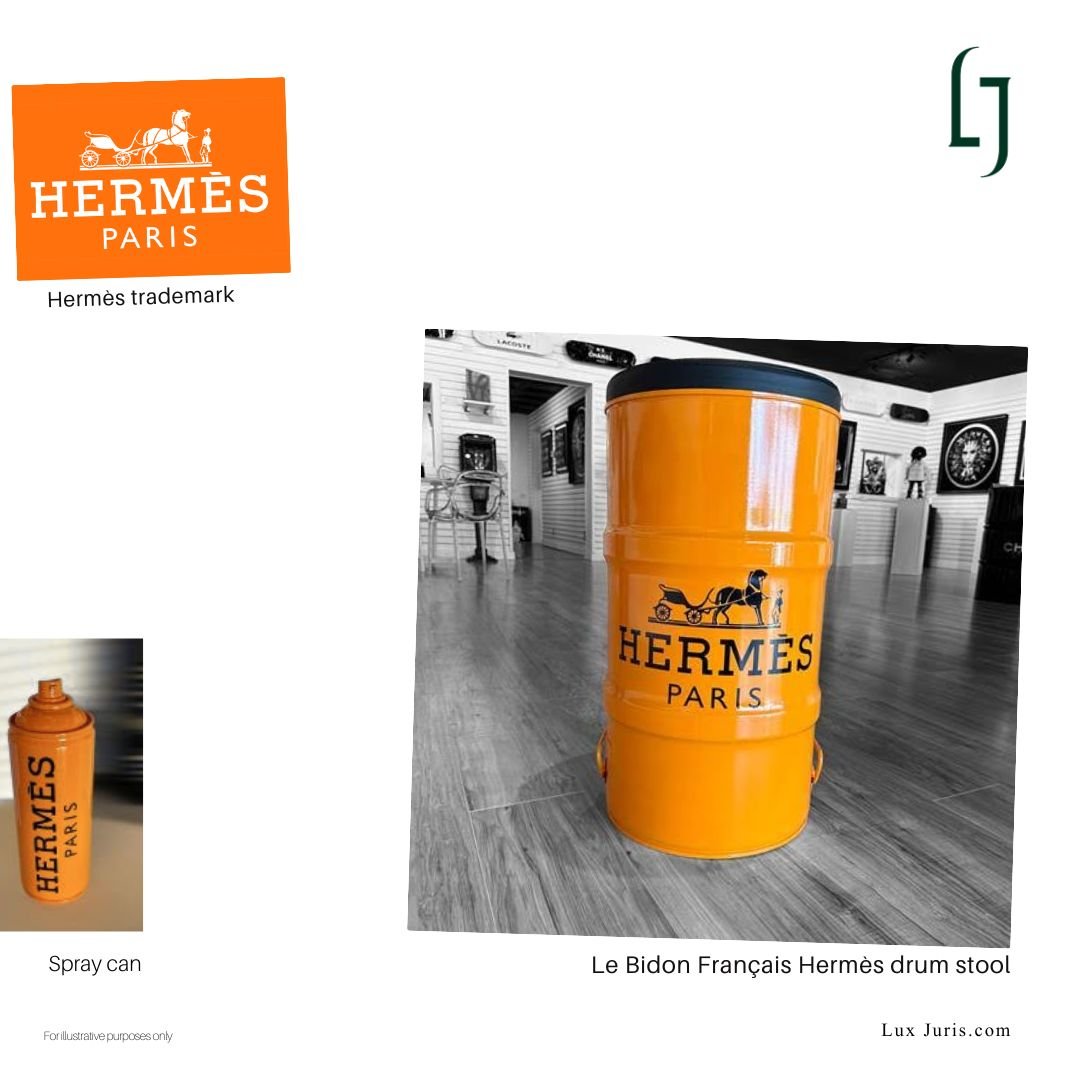
Luxury trademarks today operate far beyond their traditional role as indicators of origin. For houses like Hermès, trademarks are not merely legal assets attached to products. They have become powerful cultural symbols that communicate prestige, exclusivity and identity. As these symbols increasingly appear in artworks, decorative objects and other creative commercial projects, the legal boundary between artistic expression and trademark infringement becomes harder to draw.
That tension was central to Hermès v. Le Bidon Français, a 3 June 2026 decision of the Paris Judicial Court. The case raised a question that is becoming increasingly relevant in luxury law: can artistic expression justify the unauthorised commercial use of a famous trademark?
When a Luxury Trademark Becomes Part of the Product
Le Bidon Français is a French business known for transforming industrial objects such as barrels, fire extinguishers and other utilitarian items into decorative objects. Several of these products prominently featured Hermès signs, including the Hermès word mark and the well-known H device.
The use of Hermès branding did not stop at the product itself. The marks also appeared in product references, promotional content and online publications used to market the objects, including social media posts containing hashtags referencing Hermès. This broader commercial context became central to the dispute.
Hermès brought claims for trademark infringement, unfair competition and parasitism, arguing that its trademarks were being used without authorisation in a way that commercially benefited from the reputation and desirability associated with the brand.
At its core, the dispute was not simply about reproduction of a trademark on decorative objects. It was about whether Hermès branding had become part of the defendant’s commercial offering.
The Defence of Artistic Expression
Le Bidon Français did not deny using Hermès branding. Instead, it relied on artistic expression and parody.
According to the defendant, placing luxury branding on industrial objects created contrast, irony and satire. The creative value of the works, it argued, lay precisely in the tension between industrial material and luxury symbolism. The objects were therefore presented not as imitations of Hermès goods, but as artistic reinterpretations.
This defence reflects a broader challenge in modern trademark disputes. Once a trademark becomes culturally recognisable, it often functions as more than a badge of origin. It becomes visual language, capable of commentary, critique and creative reinterpretation.
Trademark law does recognise that artistic expression may, in some circumstances, justify third-party use of a protected sign. That protection, however, is not unlimited.
Why the Court Rejected the Defence
The court focused on the context in which Hermès’ trademarks were used, particularly the commercial setting in which the products were marketed and sold.
What mattered was not merely the presence of Hermès signs on decorative objects, but the role those signs played in product listings, promotional content and online sales channels, where they functioned as part of the commercial presentation of the goods.
That changed the legal analysis. A trademark appearing within an artwork raises different concerns from a trademark used to attract attention, increase visibility and support sales. Once a trademark begins functioning as part of a commercial strategy, the defence of artistic expression becomes far harder to sustain.
The court therefore concluded that Le Bidon Français was using Hermès trademarks in the course of trade and benefiting from the reputation and goodwill associated with the Hermès brand.
More Than Artistic Freedom
Viewing this case solely as a conflict between art and trademark law would miss an important part of the judgment. The court was equally concerned with consumer perception.
It found that consumers of decorative objects could reasonably associate the signs appearing on the products with Hermès and believe that a commercial relationship existed between Hermès and Le Bidon Français. The issue was therefore not limited to artistic reference or commercial gain. It also involved confusion.
This matters because the judgment ultimately rested on three overlapping concerns. First, the unauthorised commercial exploitation of Hermès’ reputation. Second, the risk that consumers would assume a commercial connection between the parties. Third, the weakening of Hermès’ trademarks through repeated unauthorised use.
Together, these concerns explain why the artistic defence failed.
Hermès Was Protecting More Than Product Identity
One reason this decision matters is that it shows how luxury trademark disputes have evolved.
Although the court found trademark infringement by reproduction, this was not a conventional counterfeit case involving fake handbags or imitation leather goods. The disputed products were decorative objects outside Hermès’ core product categories.
Yet Hermès still succeeded.
This reflects an important reality of luxury brand enforcement. Luxury houses are often protecting more than product identity. They are also protecting control over how their trademarks are used in the market.
For luxury brands, trademarks do more than identify source. They also carry reputation, exclusivity and consumer appeal. A mark such as Hermès can influence how consumers perceive a product even when that product has no connection to Hermès’ traditional business.
This helps explain why unauthorised trademark use may cause legal harm even where there is no direct product substitution.
The concern is not always lost sales. It may also involve dilution, banalisation and loss of control over how the brand is presented to consumers.
Conclusion
The decision in Hermès v. Le Bidon Français shows that artistic intent alone does not remove trademark risk.
What mattered in this case was the commercial use of Hermès’ trademarks. Once a trademark becomes part of product marketing, sales listings or broader commercial communication, courts are more likely to treat that use as occurring in the course of trade rather than as mere artistic expression.
This distinction carries particular relevance for artists, designers, customisers and creative businesses working with branded imagery.
As luxury trademarks increasingly carry value beyond their original products, disputes of this nature are likely to become more frequent. The legal issue will often depend less on the artistic nature of the work and more on the commercial function the trademark performs in the market.