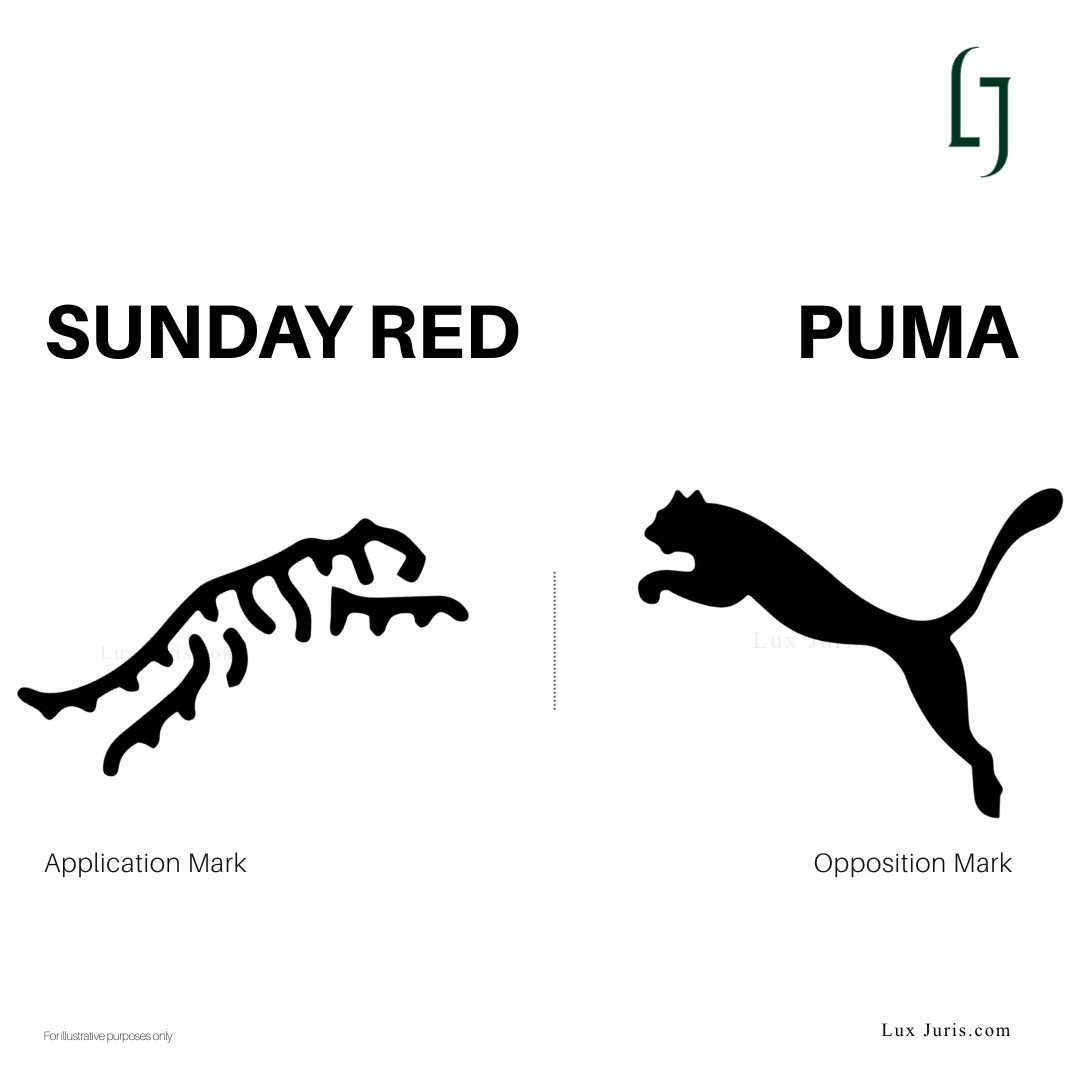
In January 2024, Sunday Red LLC, the golf and athleisure brand linked to Tiger Woods, applied to register a tiger device mark (a logo made up of an image rather than words) in Singapore. Puma opposed the application. The decision, issued on 13 March 2026 in Puma SE v Sunday Red, LLC [2026] SGIPOS 4, went in favour of Sunday Red on all grounds.
The outcome rests on a straightforward point. When the marks are considered as a whole, they are not similar. The value of the decision lies in how that conclusion is reached and what it shows about the limits of protection for animal logos.
The marks in dispute
Sunday Red’s mark consists of a tiger formed entirely from thick, spaced lines. The stripes run across the body and define the image. The entire figure is built from these lines, giving it a segmented and stylised appearance.
Puma’s mark is a solid silhouette of a leaping cat. It is drawn as a single, continuous shape, with no internal detail. The form is smooth and compact, and the movement is captured in a clean upward arc.
These are not minor visual choices. They shape how each mark is seen, remembered and recognised in the market.
How the comparison works in practice
Trade mark comparison is carried out from the perspective of the average consumer. The law assumes that consumers do not place marks side by side and study them in detail. Instead, they rely on memory, which is often imperfect.
In that setting, the overall impression of the mark becomes important. The key features that stand out are likely to remain in memory, while finer details may not.
In the Sunday Red mark, the thick lines are not an incidental feature. They are the entire composition. They are clearly visible, spaced across the body, and define the structure of the animal itself. This is not something that would be overlooked in imperfect recollection.
The Puma mark has no such internal structure. It is a solid silhouette, with a clean outline and no segmentation.
Both marks depict animals in a leaping motion. The difference lies in how that movement is expressed. The Puma cat forms a pronounced upward arc, suggesting a high leap through the air. The tiger, by contrast, appears in a flatter, more horizontal leap, closer to the ground. The direction and posture of that movement contribute to a different overall impression.
When these features are considered together, the marks create distinct visual impressions.
Why the animal itself matters
The identity of the animal plays a central role in how the mark is understood.
The stripes in the Sunday Red mark make it clear that the animal is a tiger. This is not a subtle detail. It is the defining feature of the mark and the means by which the animal is recognised. A consumer encountering this image would not describe or remember it as a generic big cat.
The Puma mark, by contrast, conveys a puma or a sleek big cat without features that point to a specific species in the same way.
Trade mark law does not operate at the level of broad categories such as big cat. The question is what the mark actually depicts and how that depiction is perceived. Where a specific animal can be clearly identified, that specificity forms part of the conceptual impression.
Style sharpens this distinction
The Puma device is smooth, continuous and anatomically streamlined. The Sunday Red tiger is segmented, constructed from separate lines, and more abstract in its appearance. These elements affect how the mark is understood and retained in memory.
Reputation is not a shortcut
Puma relied on its strong reputation in Singapore. The Registrar accepted that the brand is well known. This did not change the result.
A well-known mark does not remove the need for a proper comparison. The analysis still begins with the marks themselves, and similarity remains a threshold requirement.
The decision also reflects a less intuitive point. A strong reputation does not necessarily increase the likelihood of confusion. It can have the opposite effect.
In Singapore, the Puma device mark is commonly used together with the word Puma. This creates a clear and settled association in the minds of consumers. That association anchors the mark to a specific identity, which can make it less likely that a different animal device will be mistaken for it.
Reputation, however strong, does not bridge the gap where the marks themselves are dissimilar.
The limits of animal logos
The decision shows where the law draws the line for protection of animal logos.
Trade mark protection attaches to the sign that consumers recognise as indicating origin. It does not extend to a general idea such as the use of an animal or a category of animals.
If protection were extended too broadly, the first registrant of a common motif could claim control over all similar images. If it were too narrow, protection would be confined to a single exact drawing. The law avoids both extremes by focusing on the mark as it is perceived.
In this case, the Puma device was found to have a normal level of distinctiveness. That level of protection does not extend to all depictions of large cats in motion.
The type of animal, the way it is drawn, its internal features and the form of its movement all contribute to the overall impression. These elements determine whether another mark falls within the same conceptual and visual space.
Different countries, different outcomes
Trade mark outcomes are not uniform across jurisdictions. The same marks can lead to different results depending on how local law approaches similarity and consumer perception.
A well-known example is the long history of disputes involving the Lacoste crocodile logo. Despite the strength of the brand, courts in different countries have reached different conclusions in similar disputes.
For businesses with a global presence, this has practical consequences. A strategy that succeeds in one jurisdiction may not succeed in another. Brand owners need to account for local standards and adapt their approach accordingly.
Conclusion
Sunday Red’s tiger mark will proceed to registration and Puma’s opposition has failed. Costs were awarded against Puma, and an appeal is pending.
The strength of a global brand, however real, does not substitute for the strength of the legal argument when the marks themselves are compared carefully and without shortcut. A tiger is not a puma. That distinction, obvious in isolation, becomes legally decisive when examined through the lens of imperfect recollection and consumer perception.