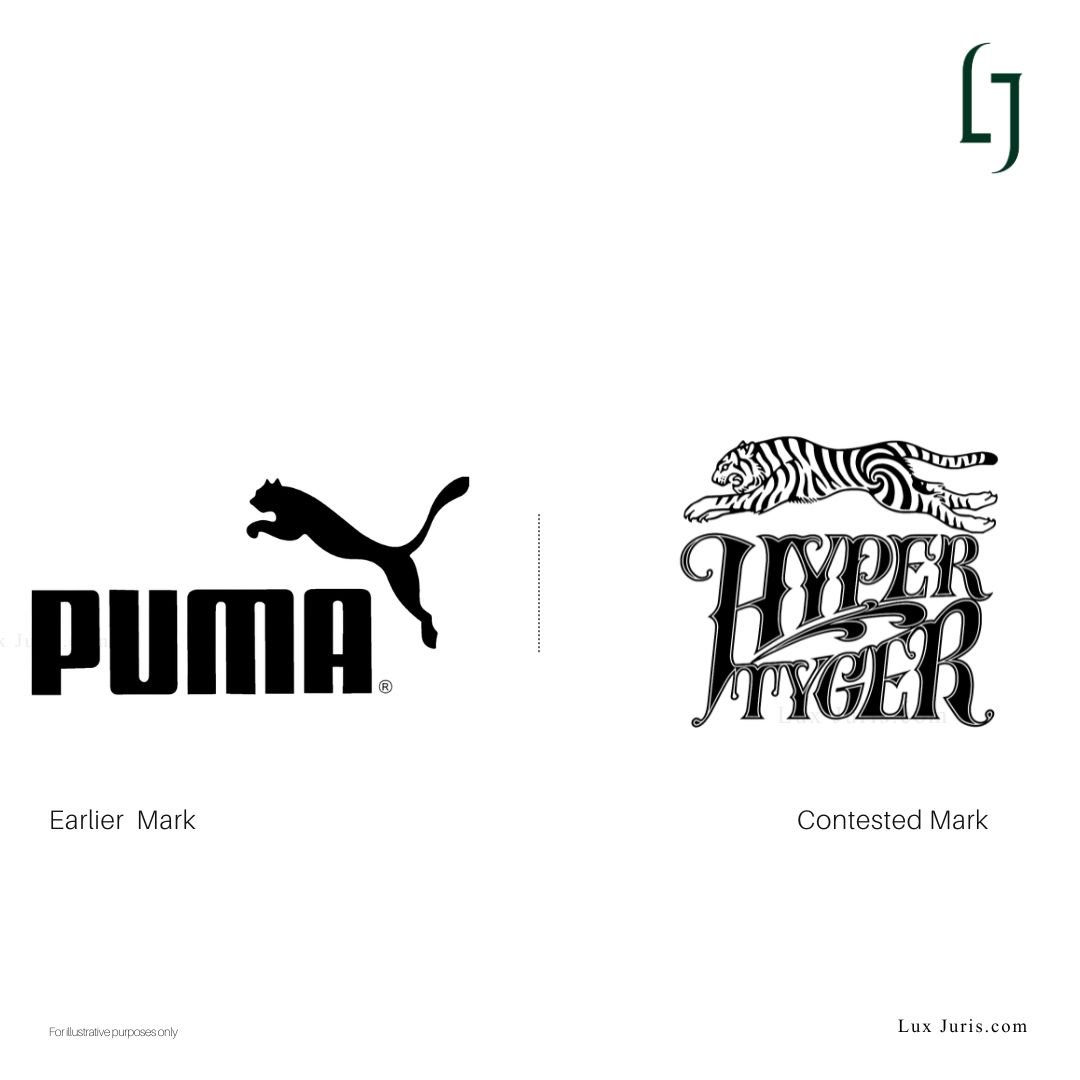
The decision in PUMA v. HYPER TYGER, issued on 27 March 2026, is not a blanket rule against using animal logos, nor does it suggest that anything resembling PUMA is automatically prohibited. The outcome is narrower, but more precise. It shows how, in certain circumstances, particularly within the European Union, a brand can be refused even without direct copying, if it enters too close to an already established commercial identity.
For businesses looking to enter the EU market, the decision offers a clear indication of how that line is assessed in practice.
The application and the overlap
The contested mark, HYPER TYGER, was applied for a full range of apparel, including clothing, footwear, and headgear such as shirts, shoes, jackets, and sportswear items. This placed it directly within the same commercial space as PUMA, whose earlier marks cover the same category of goods.
That overlap is not a minor detail. It forms the starting point of the analysis. Where two marks operate in the same market, the likelihood that consumers will encounter them in similar contexts increases, and so does the relevance of any visual or conceptual similarity between them.
A reputation that changes the analysis
PUMA begins the legal assessment. The earlier marks were not treated as ordinary trade marks. The material before the Opposition Division showed a brand with long-standing presence, strong sales, and extensive promotion across multiple markets, supported by partnerships, sponsorships, and consistent use of its visual identity.
What matters is not simply that the brand is known, but that it is recognised independently of its name. The leaping feline symbol, on its own, was shown to trigger immediate association with PUMA among a large part of the public.
This level of recognition affects how later marks are judged. It does not block all similar imagery, but it raises the threshold. A new brand entering the same space must create clearer distance, both visually and conceptually.
Similarity is not just about copying
The contested mark differs in obvious ways. It uses a different word and depicts a tiger rather than a puma. On a strict comparison, there is no imitation.
The decision moves beyond that narrow view. It looks at how the marks are structured and how they are likely to be understood in the market.
In both signs, a large feline is shown in motion, positioned above a verbal element, with the image carrying most of the impact. The overall impression is built around speed, strength, and athletic movement.
These shared elements place the marks within the same visual and conceptual field. On their own, such similarities may not always be enough to refuse a mark. However, in a situation where the earlier brand is well known and the goods are identical, they take on greater importance.
When a link becomes likely
The central question is whether consumers would connect the two marks in their minds. This does not require confusion. It is not necessary that consumers believe the goods come from the same source. It is sufficient if the later mark brings the earlier one to mind.
Here, that outcome was considered likely. The earlier mark has a strong reputation, the goods are the same, and the imagery used by both marks is closely aligned. These factors do not operate in isolation. Together, they make the formation of a mental link a predictable result of how consumers process brands in everyday situations.
The risk of gaining an unfair advantage
Once that connection is established, the next step is to consider whether the later mark would benefit from it.
The earlier PUMA marks carry a set of associations built over time, performance, movement, and sporting identity. These are not abstract qualities, they influence consumer behaviour and purchasing decisions.
The concern is that the contested mark could draw on those associations. By using similar imagery for the same type of goods, it becomes easier for the later brand to position itself in the market without building that identity independently.
This does not mean that every similar mark will be refused. The outcome depends on the specific combination of factors. In this case, the strength of the earlier brand, the similarity in concept, and the identity of goods made the advantage both plausible and foreseeable.
The EU context
This decision is particularly relevant for businesses entering the EU market. The standard applied here reflects a broader approach, where well-known marks receive wider protection.
That protection does not prevent the use of common themes such as animals or movement. However, it does require greater care where a brand operates in the same sector and uses a similar visual style.
In practice, a mark that might be acceptable in another market could face difficulty in the EU if it comes too close to an already established identity. The stronger the earlier brand, the greater the distance required.
Conclusion
The refusal of HYPER TYGER does not rest on copying, but on proximity. The marks were different in detail, yet close enough in structure and meaning to create a connection in the minds of consumers.
That connection created a risk that the later mark would benefit from the reputation of the earlier one without making the same investment.
For brands, the lesson is not to avoid entire categories of imagery, but to understand how those images are already used in the market. In the EU, where a brand has built a strong and recognisable identity, entering the same conceptual space requires careful design choices.
Distance is measured not only by difference in name or form, but by how the mark will be perceived in context.