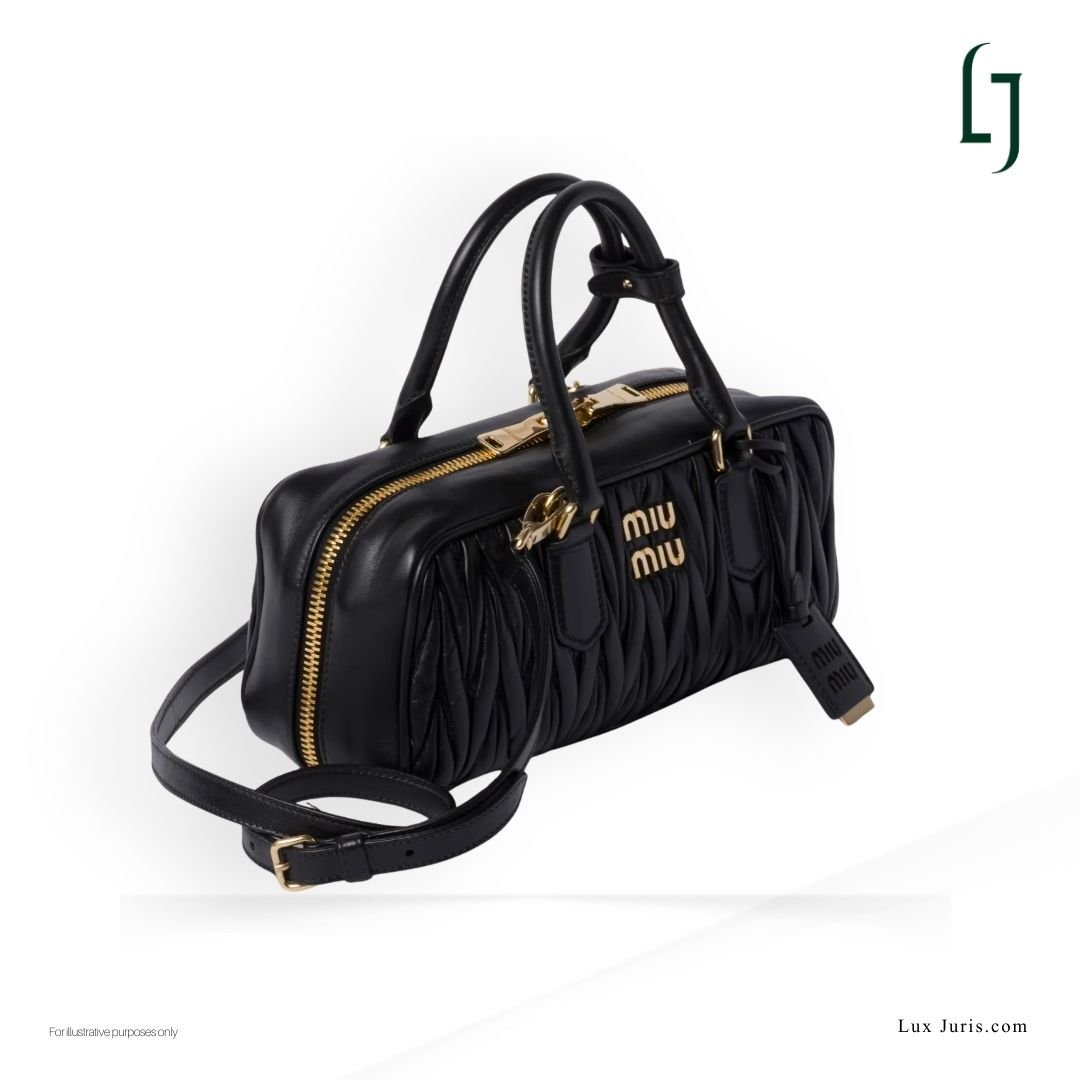
MIU MIU is a long-established brand within the Prada group’s portfolio, used for ready-to-wear, footwear and leather goods, including handbags. At the time the Opposition Division delivered its decision on 14 January 2026 in Prada S.A. v. Guangzhou Min Min Leather Co., Ltd, the mark was supported by a dense network of branded retail stores across several Member States, sustained levels of sales over many years, and regular coverage in international fashion and business publications.
The evidence before the Office demonstrated continuous and significant commercial use of MIU MIU in relation to handbags in particular, a category in which the mark has achieved a high level of recognition among the relevant public, at least in France. This factual position shaped the legal assessment that followed.
The opposition before EUIPO
The contested EU trade mark application concerned a figurative sign built around the repeated words “MIN MIN”, filed for a wide range of Class 18 goods, including handbags, bags, luggage, animal skins, and imitation leather. Prada opposed the application relying primarily on its earlier EU word mark MIU MIU, invoking both likelihood of confusion under Article 8(1)(b) EUTMR and reputation under Article 8(5) EUTMR. The Opposition Division upheld the opposition in full and rejected the application for all contested goods.
How the signs were assessed
The earlier mark MIU MIU was found to be normally distinctive. It has no meaning for the relevant public in the European Union and therefore functions solely as an indicator of commercial origin.
The applicant’s sign MIN MIN was also considered normally distinctive. Although the word “min” may carry meanings such as “minute” or “mine” in certain languages, those meanings are not descriptive of the goods concerned. The Office therefore did not treat the contested sign as weak.
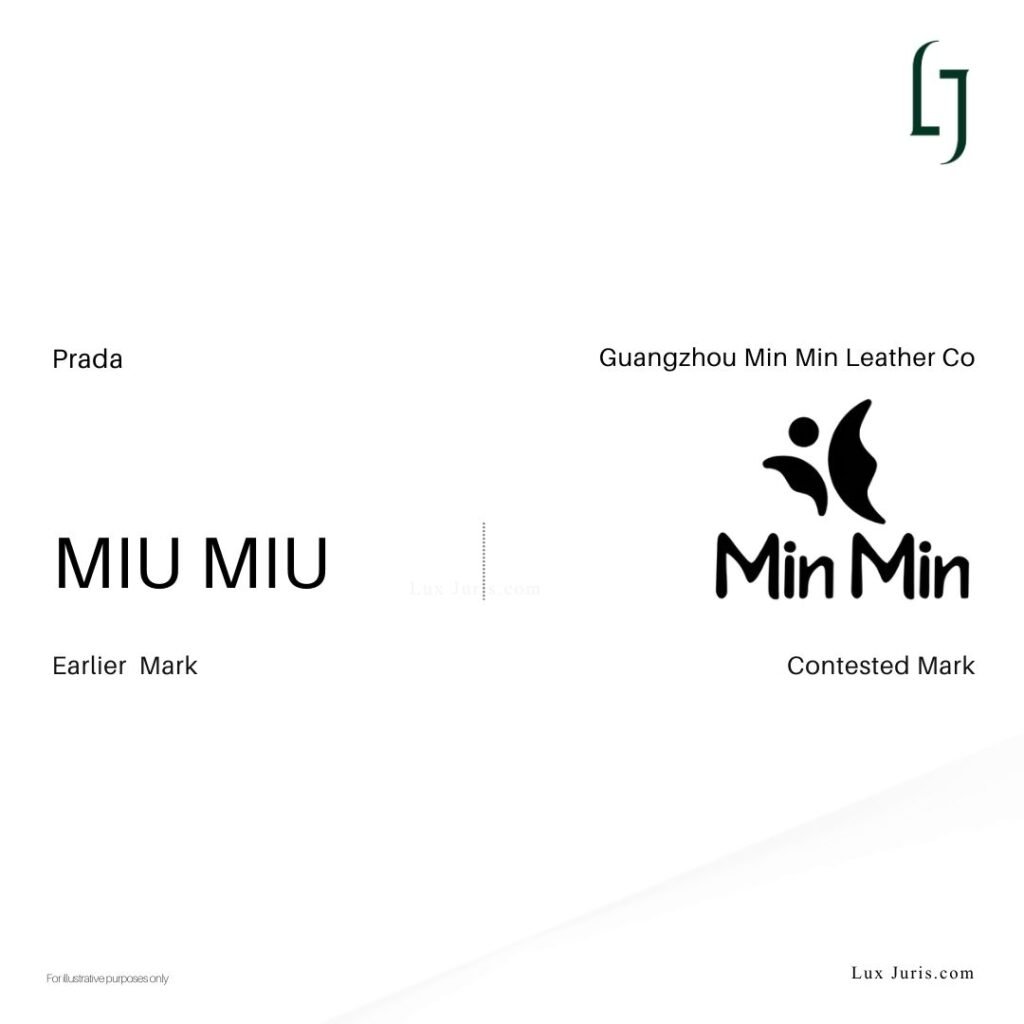
Assessment of the signs
Both signs consist of a three-letter element repeated twice. Both rely on repetition as their defining feature. Both begin with “mi”. Visually and aurally, the Opposition Division found the signs to be similar to an above-average degree. The difference between the final letters “u” and “n” was considered insufficient to offset the overall similarity, particularly given their position at the end of the repeated elements.
The figurative components of the contested sign, including small graphic shapes, were regarded as decorative. In line with established EU case law, the Office reiterated that consumers tend to focus on verbal elements when identifying and recalling trade marks.
Conceptually, the signs were not similar, as MIU MIU has no meaning. That finding did not prevent a conclusion of similarity overall, since visual and phonetic similarity alone was sufficient to proceed.
The goods and the first legal boundary
For handbags, wallets, and closely related items, the goods were found to be identical or similar to varying degrees.
A different conclusion was reached for animal skins and imitation leather under Article 8(1)(b). The Opposition Division drew a clear distinction between finished consumer goods and raw or semi-processed materials. These goods differ in nature, purpose, method of use, distribution channels and target public.
The fact that leather may be used in the manufacture of handbags was not enough to establish similarity for the purposes of likelihood of confusion. EU trade mark law does not treat a production relationship as equivalent to consumer perception. At this stage, the opposition could not succeed for those materials under Article 8(1)(b).
The effect of reputation
The Office examined Prada’s evidence in detail, including the existence of MIU MIU stores across several Member States, long-term sales figures, audited financial documentation, extensive press coverage and industry recognition.
The Opposition Division was careful to define the scope of its findings. It concluded that MIU MIU enjoys a strong reputation in at least France, and that this reputation is most clearly established in relation to handbags.
That finding was sufficient to engage the enhanced protection afforded to reputed marks.
Why real leather were reconsidered
Although animal skins and imitation leather were dissimilar to handbags for the purposes of confusion, the Office found them closely connected when assessing whether the relevant public would establish a mental link between the signs.
The reasoning was grounded in consumer perception. Handbags are commonly described, marketed, and differentiated by reference to their materials. Leather is a central feature in how such goods are presented and understood. As a result, real leather and imitation leather are not perceived as remote from handbags, but as materials directly associated with their production.
This association does not depend on technical knowledge of the manufacturing process. It operates at a general level of understanding. Handbags are among the most visible and widely recognised leather goods on the market, and consumers naturally associate materials with the finished products made from them.
On that basis, the Opposition Division concluded that the relevant public would establish a link between the contested sign and the earlier MIU MIU mark, despite the difference in the stage of production.
Unfair Advantage Without Confusion
Prada argued that use of the contested sign would take unfair advantage of the reputation of MIU MIU. The Opposition Division agreed.
The issue was not whether consumers would believe the goods originated from the same undertaking. It was whether the applicant would benefit from the power of attraction, image, and commercial value of the earlier mark without making a corresponding investment.
MIU MIU was shown to be associated with fashion positioning, quality, and desirability, particularly in relation to handbags. The use of a structurally similar, repetitive sign on goods closely connected to that category was likely to make marketing easier for the applicant through association alone.
EU law does not require proof of actual harm at the opposition stage. It is sufficient to show that unfair advantage is likely to arise in the normal course of events. The Office found that threshold met. The applicant did not advance any due cause for using the contested sign.
Once unfair advantage was established, there was no need to examine dilution or detriment to reputation. A single form of injury is sufficient for Article 8(5) to apply.
Conclusion
This decision confirms that repetition is not neutral in EU trade mark law. Where a mark has achieved sustained market recognition, its structure and rhythm form part of what consumers identify and remember.
Goods may be clearly distinct for confusion purposes and still be considered too close once reputation is taken into account. Materials and finished products may be separated in the supply chain, but not necessarily in the consumer’s mind.
For fashion and luxury brands: once a mark has an established presence in the market, protection is not limited to its exact spelling, but extends to its sound, structure, and the way it is recalled by consumers. That protection is not theoretical. It operates in practice.
Source: