
J’ADORE v. ADORE Professional: Reputation and the Limits of Brand Differentiation in EU Trade Mark Law
The EUIPO Opposition Division’s decision of 13 January 2026 confirms the continuing reach of reputation-based protection in EU trade mark law. The opposition, filed by Parfums Christian Dior, succeeded in blocking the registration of ADORE professional for manicure and pedicure products and related services, on the basis of the earlier mark J’ADORE.
The decision turns on reputation, similarity of signs, and the likelihood that the later mark would benefit from the earlier mark’s established market position, even in the absence of direct product overlap.
J’ADORE and Its Commercial Standing
The earlier mark J’ADORE belongs to Parfums Christian Dior, part of the Dior group founded by Christian Dior. The fragrance was launched in 1999 and has been marketed continuously since then.
Based on extensive evidence covering sales figures, advertising investment, market rankings, press coverage, awards, and prior administrative decisions, the Opposition Division found that J’ADORE enjoys a significant reputation in the European Union for perfumery in Class 3, well before the filing date of the contested mark in April 2024.
The mark was recognised as being widely known by a substantial part of the relevant public and as having maintained a strong and stable position in the EU fragrance market over a long period.
The Contested Mark: ADORE Professional
The application concerned the figurative sign ADORE professional, covering a wide range of nail care products in Class 3 and commercial, promotional, and retail-related services in Class 35.
In assessing the sign, the Opposition Division identified ADORE as the dominant verbal element. The word professional was considered descriptive for the goods and services concerned, as it merely suggests intended use or target audience and does not indicate trade origin.
As a result, the comparison of signs focused primarily on the shared element ADORE.
Comparison of the Signs
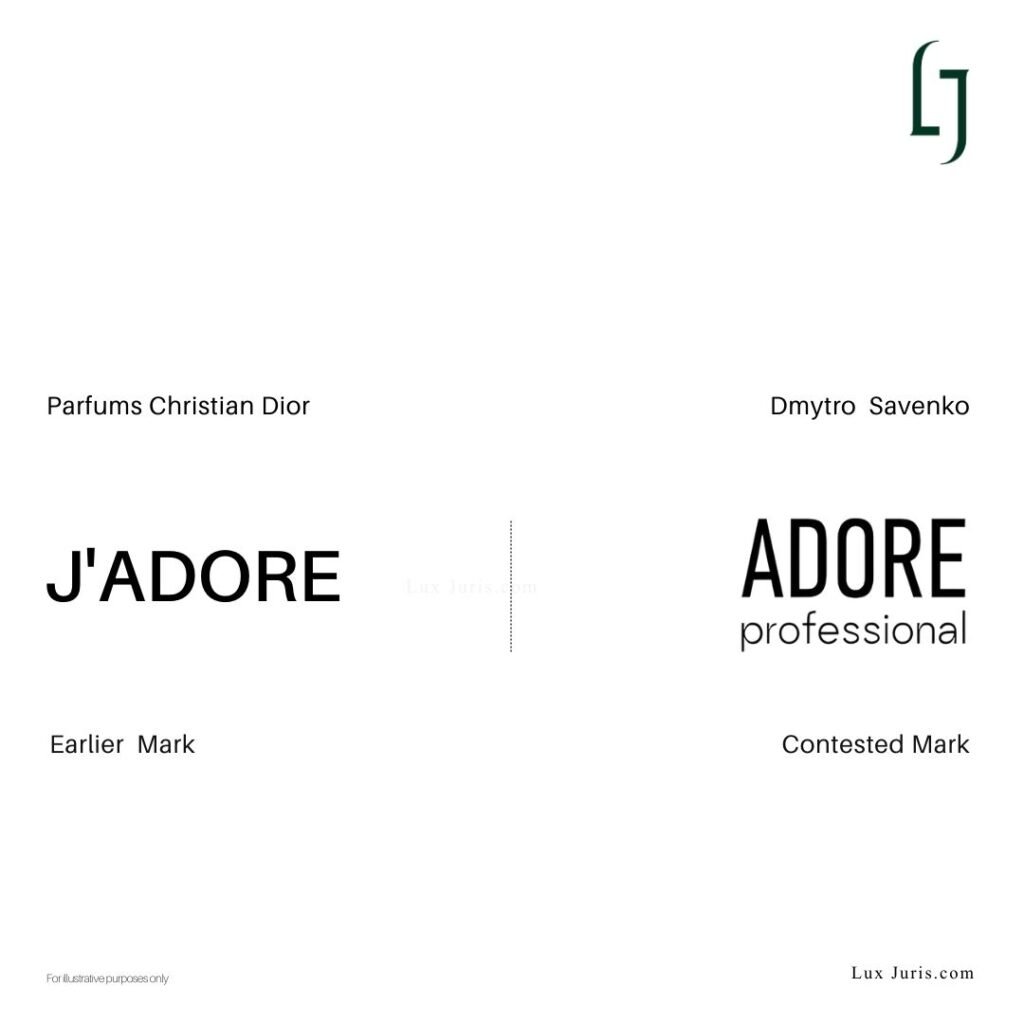
Visually, the signs coincided in the element ADORE, which constitutes the most prominent part of both marks. The presence of the letter “J” and the apostrophe in J’ADORE, as well as the additional word “professional” in the contested mark, were not sufficient to counterbalance that similarity.
Aurally, the signs were found to be highly similar. The Division accepted that consumers tend to refer to marks by their dominant element and are unlikely to articulate weak or descriptive components.
Conceptually, for a significant part of the EU public, both signs convey the same idea linked to the verb “to adore”. Any difference again stemmed from the word “professional”, which carried limited weight in the assessment.
Overall, the signs were considered similar to an above-average degree.
Goods, Services, and Market Context
Although the earlier mark is registered for perfumery and the contested application concerned nail care products and related services, the Opposition Division rejected a strict separation between these categories.
Nail products, cosmetics, and perfumes all fall within the broader field of beauty and personal care. They are often offered through the same distribution channels, used for related purposes, and addressed to the same consumers. In this context, the Division found that the nature of the goods and services reinforced, rather than weakened, the association created by the similarity of the signs.
The same reasoning applied to the Class 35 services, which were directly linked to the marketing and sale of beauty products.
The Mental Association Between the Marks
The Opposition Division concluded that, given the reputation of J’ADORE, the similarity of the signs, and the shared commercial environment in which the goods and services operate, consumers were likely to make a mental association between J’ADORE and ADORE professional.
That association did not require confusion as to origin. It was sufficient that the later sign would call the earlier mark to mind.
Unfair Advantage
The opposition succeeded on the basis that use of ADORE professional would be likely to take unfair advantage of the reputation of J’ADORE, within the meaning of Article 8(5) EUTMR.
The Division accepted that the positive qualities associated with the earlier mark could transfer to the contested sign, making the marketing of the applicant’s goods and services easier than would otherwise be the case. The applicant’s arguments concerning good faith and lack of intent to imitate were dismissed as irrelevant, since unfair advantage does not depend on intention but on likely effect.
Having established a likelihood of unfair advantage, the Division considered it unnecessary to examine other forms of potential injury.
Conclusion
The opposition was upheld in full, and the EU trade mark application for ADORE professional was rejected for all goods and services.
The decision illustrates how reputation operates in practice under EU trade mark law, particularly in sectors where brand image extends across related product categories. It also shows that the addition of descriptive or secondary elements does not neutralise similarity where the dominant element corresponds to an earlier mark with established reputation.
Source: